Rose Quartz or Shoushan Stone? The Captivating Beauty of China’s “Furong” Gems
Most crystal lovers know Rose Quartz as the ultimate “Stone of Love.” However, few realize it shares a beautiful Chinese name: Furong Stone (Hibiscus Stone). Even fewer know that another rare treasure—Shoushan Furong, a prestigious seal stone rather than a jade—shares this same name, both prized for their resemblance to the delicate beauty of a blooming hibiscus flower.
Today, we’re diving into the dual world of Furong Stone. Whether you are drawn to the dreamy translucency of pink crystal bracelets for daily wear or the buttery, wax-like luster of Shoushan stone seals, this guide helps you distinguish, value, and collect these two stunning varieties with confidence.
📖Table of Contents
- Rose Quartz Furong Stone: The Original “Stone of Love”
- Qianlong Rose Quartz Incense Burner: A Famous Furong Stone Artifact
- Imperial Craftsmanship and Design Details
- Pan-Chi Dragons: Symbolism in Furong Stone Carvings
- Qianlong Rose Quartz Incense Burner: A Famous Furong Stone Artifact
- Gemological Profile of Rose Quartz (Quartz-Type Furong Stone)
- 2025 Market Price Guide: Rose Quartz Bracelets
- Commercial / Everyday Grade
- Medium / Refined Grade
- High-End / Collector Grade
- Collector Tips
- 2026 Buying Guide: How to Choose Rose Quartz Furong Stone
- Color, Transparency, and Natural Glow
- Transparency and Clarity
- Carat Weight and Density
- Precision Cut and Polish
- Authentication and Source
- Investment and Collectibility
- Caring for Rose Quartz Furong Stone
- Avoid prolonged sunlight
- Clean gently and infrequently
- Store with care
- Shoushan Furong Stone: The “Stone Queen” of Imperial China
- An Introduction to Shoushan Furong
- A Legacy of Imperial Favor
- Types of Shoushan Furong Stone by Mining Origin
- Jiangjun Dong (General’s Cave) Furong Stone
- Banshan (Half-Mountain) Furong Stone
- Xi Dan (Stream Egg) Furong Stone
- Key Characteristics of Shoushan Furong Stone
- Texture and Luster: The Feel of Silk
- Classic Furong Stone Color Categories
- Cultural and Investment Value of Shoushan Furong Stone
- Rarity, Exhausted Mines, and Scarcity
- Market Stability and Long-Term Value Retention
- Imperial Seals, Scholars, and Historical Legacy
- 2025 Market Prices for Shoushan Furong Stone
- Entry-Level & Decorative
- Premium / Investment Grade
- Museum-Grade & Historical
- Example: The Liu Xian Pair
- How to Authenticate Shoushan Furong Stone
- Cross-Section and Cut Surface Examination
- Internal Texture and “Stone Vein” Identification
- Final Thoughts: Market Outlook and Collecting Perspective
Rose Quartz Furong Stone: The Original “Stone of Love”
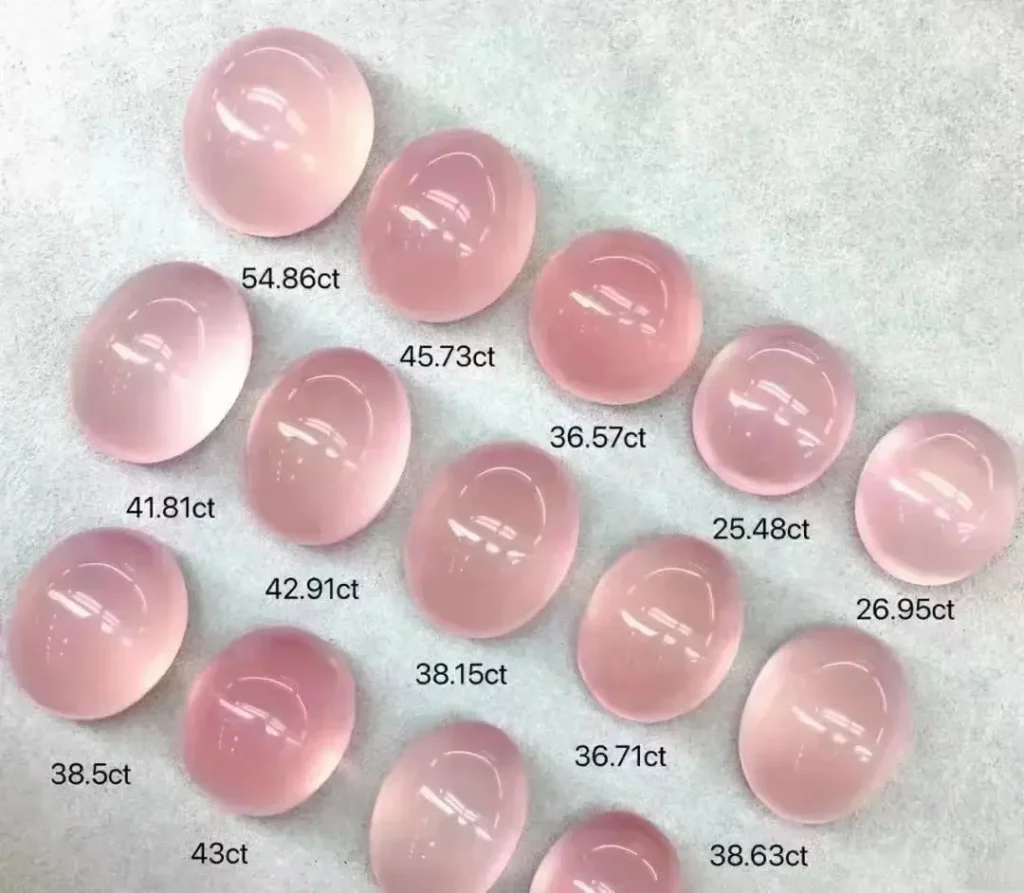
In the West, Rose Quartz is cherished as a heart-healing crystal linked to love and emotional balance. In Chinese tradition, this same material carries a beautiful and poetic name: Furong Stone.
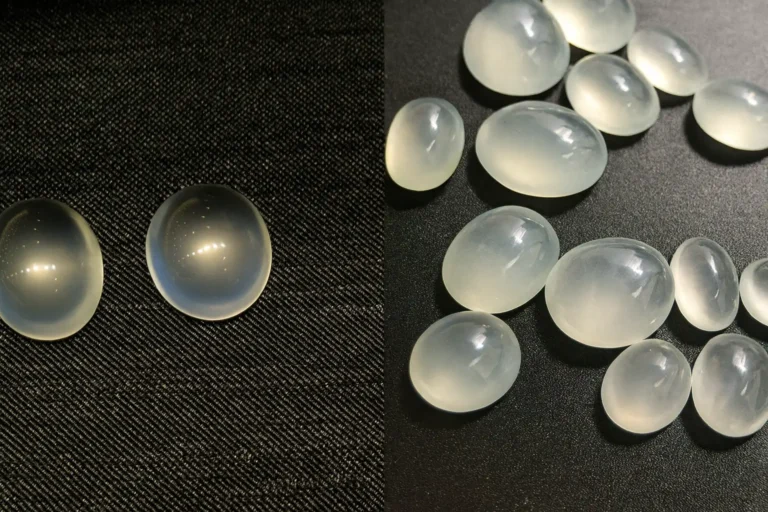
Unlike Shoushan Furong, which is a rare mineral stone, this variety belongs to the quartz family. Nevertheless, jewelry enthusiasts still cherish it for its soft translucency and delicate pink hues. These romantic tones have remained a timeless fashion staple for centuries—transitioning seamlessly from ancient imperial adornments to the versatile, everyday jewelry of today.
Qianlong Rose Quartz Incense Burner: A Famous Furong Stone Artifact
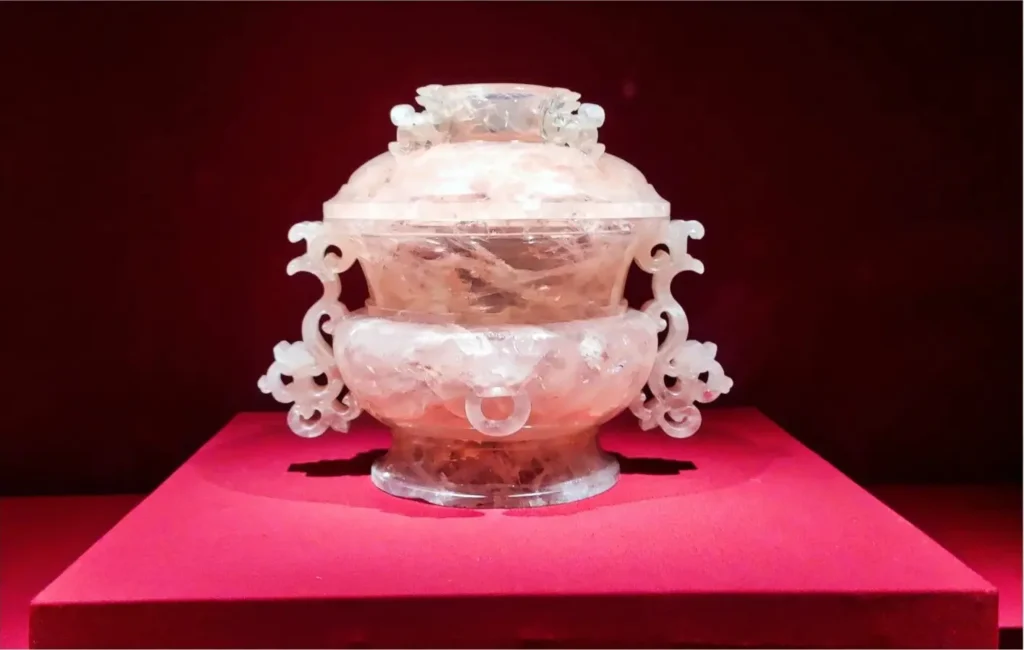
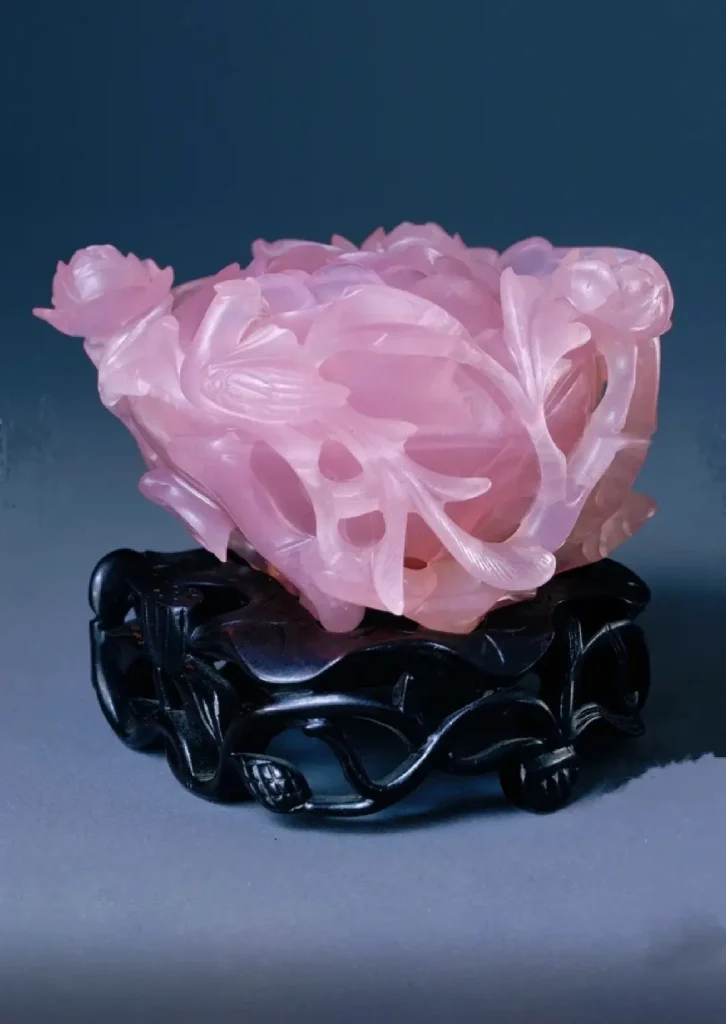
To see the true beauty of this stone, look no further than history. Even the ancient Chinese imperial court fell for the charm of its delicate pink hue. Among their most famous treasures is a masterpiece of craftsmanship: the Qianlong-era Rose Quartz Incense Burner.
Now housed in the Nanjing Museum, China, this object has become widely admired online. Many viewers call it the “First Love” of ancient artifacts because of its tender color and remarkable clarity.
The vessel stands 17 cm tall and measures 14.9 cm in diameter. Craftsmen carved it from a single, massive block of rare pink Rose Quartz, a feat that highlights both material quality and imperial resources.
Imperial Craftsmanship and Design Details
- Refined Carving
The body features symmetrical Pan-Chi dragons and animal-mask ring handles. Four smaller dragons crown the lid, creating a balanced and dignified form. - Imperial Taste
The translucent glow reveals the softer side of Emperor Qianlong’s aesthetic preferences. Even powerful rulers valued the emotional symbolism of the Stone of Love. - Natural Crystal Structure
Subtle internal veining remains visible across the surface. These natural patterns confirm the authenticity and quality of high-grade Furong Stone.
Pan-Chi Dragons: Symbolism in Furong Stone Carvings
The dragon motifs on this incense burner carry deep cultural meaning. The Pan-Chi is an early, hornless dragon found in ancient Chinese mythology.
Historical sources describe this creature in two main ways:
- The Protective Hybrid
Some legends portray the Pan-Chi as a union of dragon and tiger. It combines authority with courage, which explains its frequent appearance on military banners, seals, and weapons. - The Feminine Dragon
Other records, including the Book of Han, identify the “Red Chi” as a female dragon. This interpretation emphasizes grace, balance, and inner strength.
Together, these meanings make the Pan-Chi an ideal guardian for Rose Quartz. The pairing unites power with tenderness, echoing the dual nature of Furong Stone itself.
Gemological Profile of Rose Quartz (Quartz-Type Furong Stone)
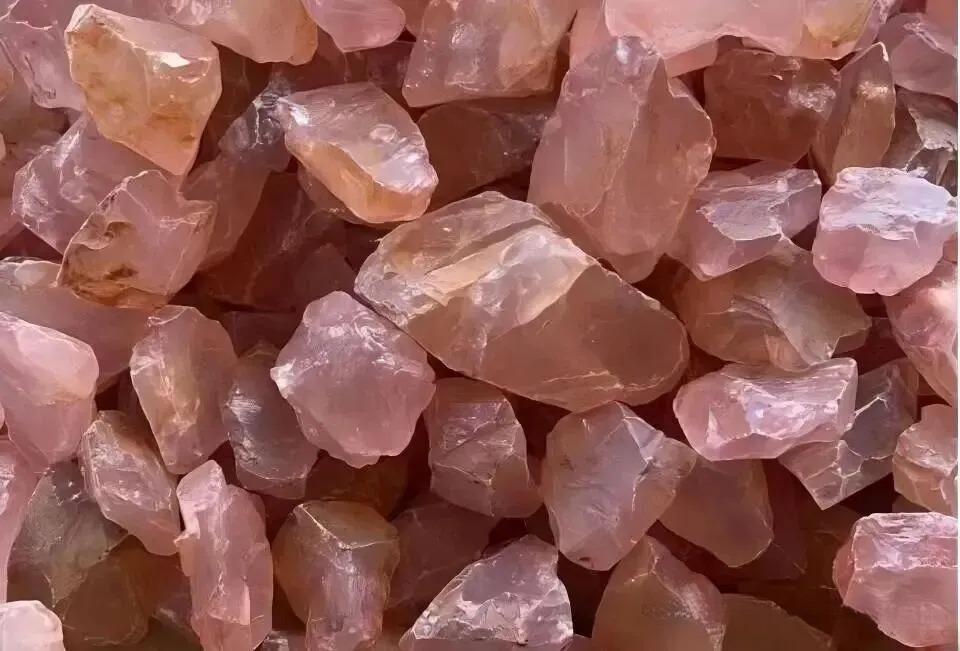
For collectors interested in the technical and gemological aspects, the table below outlines the key properties of Rose Quartz, known in Chinese tradition as quartz-type Furong Stone.
| Gemological Feature | Details |
|---|---|
| Mineral Category | Silicate Mineral (Quartz) |
| Crystal System | Trigonal |
| Mohs Hardness | 7 — suitable for daily wear with proper care |
| Common Names | Rose Quartz, Furong Stone, Stone of Love |
| Color Range | Pale pink to deep rose-red |
| Color Origin | Trace amounts of titanium, iron, or manganese |
| Transparency | Transparent to translucent |
| Major Sources | Madagascar, Brazil, South Africa (Orange River), China, Kazakhstan |
Rose Quartz typically forms as massive quartz rather than individual visible crystals. While it offers good durability, the material can be brittle along natural internal fractures. For this reason, skilled artisans emphasize precise cutting and secure settings to ensure long-term stability and beauty.
For readers who wish to explore quartz formation in greater depth—including crystal growth patterns, common inclusions, and reliable methods for identifying natural versus treated quartz—see our in-depth resource:The Ultimate Guide to Natural Quartz Crystals: Types, Inclusions, and Authenticity
2025 Market Price Guide: Rose Quartz Bracelets
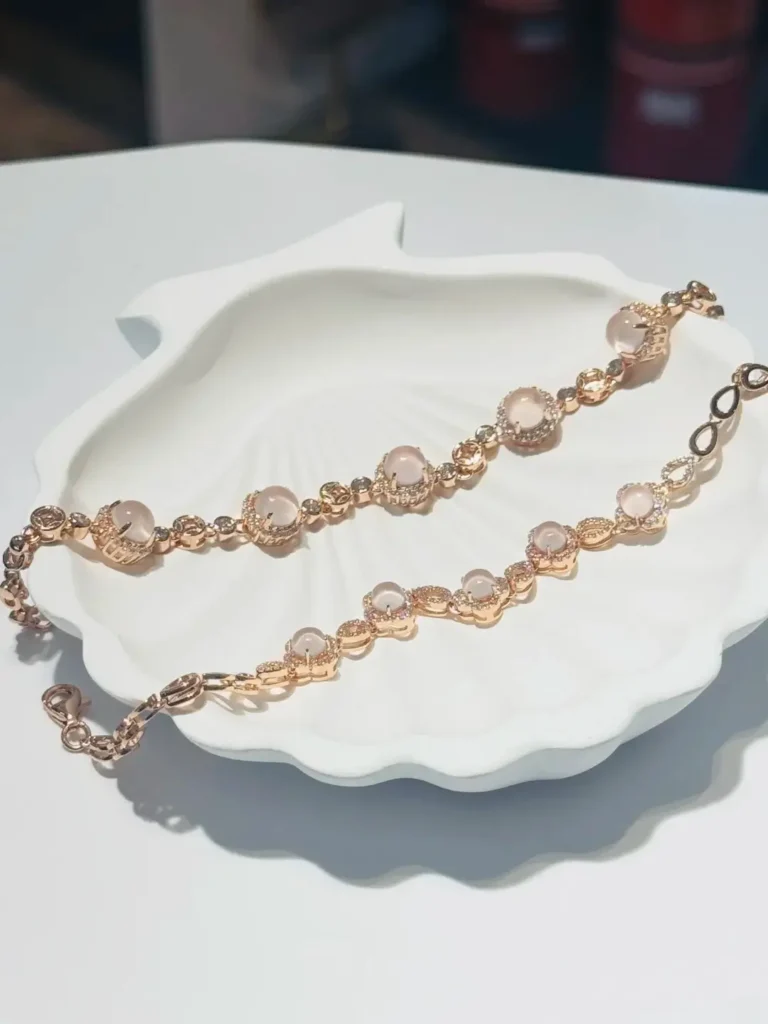
The price of Rose Quartz Furong Stone varies widely depending on color saturation, transparency, clarity, and craftsmanship. Rarity and optical phenomena, such as asterism (star effect), also influence value.
Commercial / Everyday Grade
Approx. $5–$50 USD per bracelet or strand
These pieces are ideal for casual wear. They often contain visible “cotton” inclusions or minor internal fractures, but retain the signature soft pink color of Rose Quartz.
Medium / Refined Grade
Approx. $50–$150 USD per bracelet or strand
This tier offers better transparency and more even coloration. Some pieces may feature Star Rose Quartz, displaying a subtle six-rayed star under strong direct light. These beads or bracelets also show improved polish and bead symmetry.
High-End / Collector Grade
Approx. $150–$300+ USD per bracelet or strand
Reserved for rare, eye-clean specimens with vivid color and superior clarity. Prices can rise further when brand prestige, artisanal design, or unusually large beads are involved. Exceptional Star Rose Quartz or deep rose-red shades may appear in this category, but these are extremely rare and highly sought after by collectors.
💡 Collector Tip:
For investment-grade pieces, clarity and natural color significantly impact long-term value.
Inspect Star Rose Quartz under direct light to ensure the star rays are sharp and symmetrical.
Avoid stones with overly intense or uniform pink, as this may indicate dye treatment.
2026 Buying Guide: How to Choose Rose Quartz Furong Stone
Now that we’ve covered current market prices, it’s time to explore how to choose Rose Quartz (quartz-type Furong Stone) that combines beauty, quality, and long-term value. Whether you’re a casual crystal lover or a serious collector, these expert tips will help you make an informed decision.
1. Color, Transparency, and Natural Glow
Color drives the value of Rose Quartz. Shades range from pale blush to deep rose-pink, but the most desirable stones feature vivid, evenly distributed pink tones. In larger pieces, look for a natural “glowing” warmth rather than flat, artificial color. For Star Rose Quartz, the six-rayed star should appear sharp, symmetrical, and centered under a single direct light source.
2. Transparency and Clarity
While most Rose Quartz is naturally translucent or slightly cloudy due to microscopic inclusions, high-grade specimens—often called “ice-kind” Furong—are exceptionally transparent, appearing as clear as water.
Subtle natural markings such as fine “cotton” inclusions or silk-like internal lines prove authenticity and do not diminish value. Avoid overly flawless or unnaturally bright pink stones that may be dyed.
3. Carat Weight and Density
Rose Quartz is denser than many imitation crystals. A genuine piece feels cool and substantial in your hand relative to its size. Larger stones often show deeper color saturation, making them highly sought after by collectors and skilled carvers.
4. Precision Cut and Polish
The cut and polish significantly enhance a stone’s appearance. Whether faceted or cabochon, the surface should have a high-gloss, greasy luster. Look for smooth curves and precise facets that maximize brilliance and depth of color.
5. Authentication and Source
Always purchase from reputable dealers and request a Gemstone Identification Certificate from recognized labs (such as GIA or local authoritative institutions). This ensures your Furong Stone is genuine, untreated, and accurately graded.
6. Investment and Collectibility
The value of Rose Quartz depends on rarity, historical context, and quality. Commercial beads are affordable, but high-clarity carvings or historically significant artifacts can command substantial prices. Prioritize stones with vivid color, excellent transparency, and minimal fractures to ensure a collection that retains both aesthetic beauty and long-term value.
Caring for Rose Quartz Furong Stone
Proper care helps preserve the soft, “first love” glow that makes Rose Quartz Furong Stone so desirable. Because this stone is naturally photosensitive, daily handling and storage play an important role in maintaining its color and clarity.
Avoid prolonged sunlight
Rose Quartz can fade when exposed to strong, direct sunlight for extended periods. To protect its delicate pink hue, remove your Furong Stone jewelry before sunbathing or long outdoor activities, and store it away from intense light when not in use.
Clean gently and infrequently
Use lukewarm water and a mild soap to clean your stone. Gently wipe it with a soft cloth, then rinse and dry thoroughly. Avoid harsh chemicals, ultrasonic cleaners, and steam cleaning, as these methods may damage the stone’s internal structure.
Store with care
Keep Rose Quartz Furong Stone in a soft pouch or a lined jewelry box to prevent scratches. Store it separately from harder gemstones to preserve its smooth surface and natural luster.
With thoughtful care, Rose Quartz Furong Stone will retain its soft blush, inner glow, and timeless charm for years to come.
Shoushan Furong Stone: The “Stone Queen” of Imperial China
While Rose Quartz is a beloved choice for wearable jewelry, elite collectors often turn their attention to a far rarer variety of Furong Stone—Shoushan Furong, a material deeply rooted in Chinese imperial history. Recognized as one of the Three Treasures of Seal Stones, it has gained renewed international attention in recent years.
An Introduction to Shoushan Furong
Shoushan Furong is traditionally regarded as the most esteemed variety within the Mountain Pit (Shan Keng) category of Shoushan stones. Its name derives from its soft, luminous coloration, reminiscent of a hibiscus flower in first bloom—furong in Chinese.
Origin & Composition:
Unlike crystalline Rose Quartz, Shoushan Furong is a pyrophyllite-type gemstone. While pyrophyllite occurs worldwide, collector-recognized Shoushan Furong originates from the Shoushan stone system, with the Mount Jialiang mining area in Fuzhou, China considered its most important and prestigious source.
Why It Is Called the “Stone Queen”:
Shoushan Furong is celebrated for its exceptionally fine-grained, buttery texture—often described in classical texts as feeling like fat or ointment. It possesses the soulful warmth of jade without being a silicate jade itself, a rare balance that earned it the honorary title “The Stone Queen.”
A Legacy of Imperial Favor
The cultural pedigree of Shoushan Furong is unparalleled. During the Qing Dynasty, the scholarly work Guan Shi Lu (The Record of Observing Stones) praised its texture as “rich as grease, smooth as cream, and supple as marrow.”
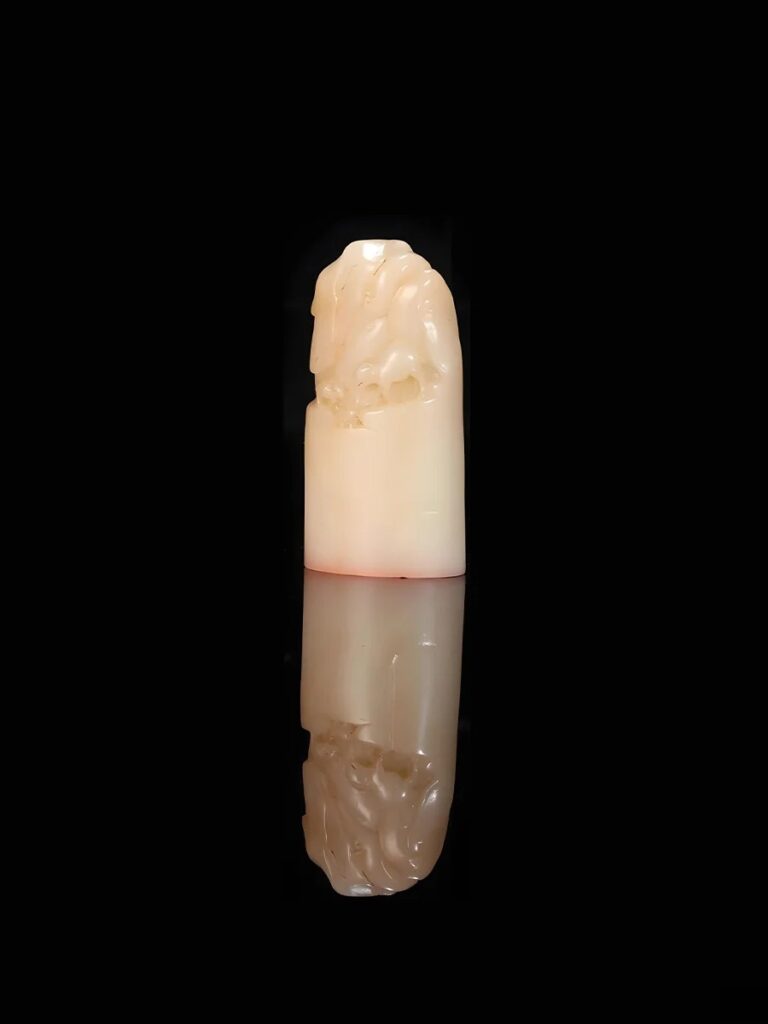
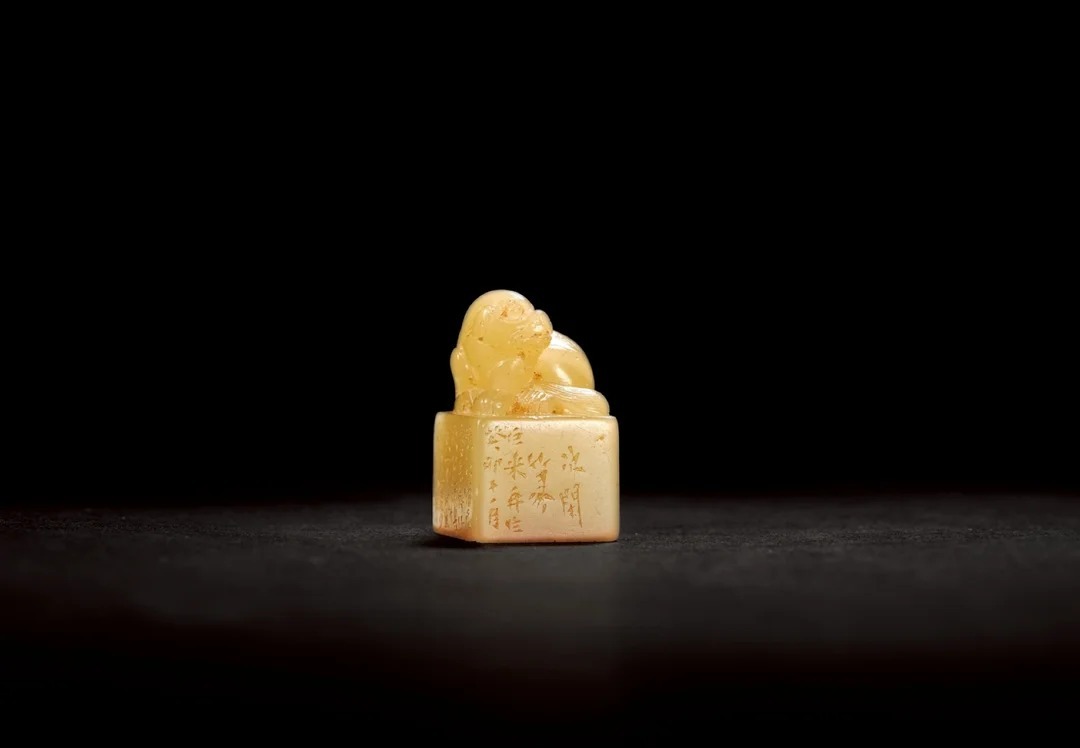
This extraordinary tactile quality made Shoushan Furong the preferred material for imperial seals. Emperors Kangxi and Qianlong both selected it for their personal use, elevating the stone from a natural mineral to a lasting symbol of royal authority and refined taste.
Types of Shoushan Furong Stone by Mining Origin
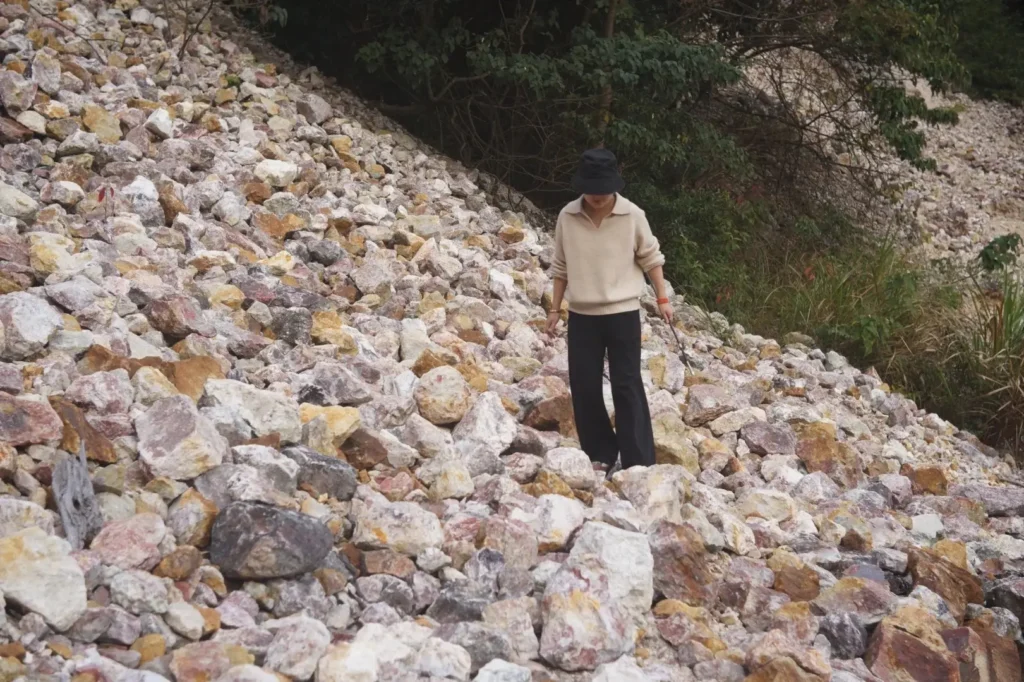
Although many Furong stones may look similar at first glance, collectors categorize them based on mining location and texture, which strongly affects rarity and value. Let’s explore the main types:
Jiangjun Dong (General’s Cave) Furong Stone
Mined at the mountain peak, this type is exceptionally pure and flawless. The most coveted variety, Lotus Root Tip White, is translucent and delicate, resembling frozen nectar. Sadly, the Jiangjun Dong cave is now completely exhausted, making these stones rare antique treasures.
Banshan (Half-Mountain) Furong Stone
Mined from mid-mountain, these stones are slightly harder and more transparent than peak Furong. They offer a vibrant palette of whites, reds, and yellows, ideal for intricate carvings.
Xi Dan (Stream Egg) Furong Stone
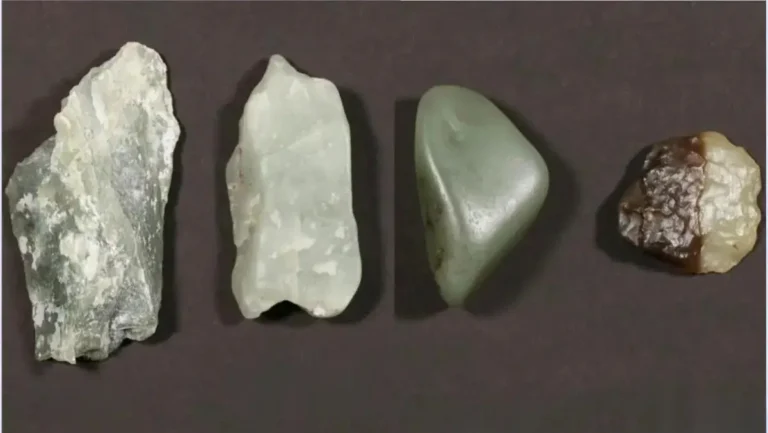
These stones broke off from primary ore and tumbled into mountain streams over millennia. Naturally polished by water, they are small, smooth, and round. Though they may resemble the famous Tianhuang stone, they lack the “radish veins” and display the unmistakable waxy soul of Furong.
Collectors should note that Jiangjun Dong and Banshan Furong stones are highly prized in auctions, often fetching significant prices due to their rarity and historical significance.
Key Characteristics of Shoushan Furong Stone
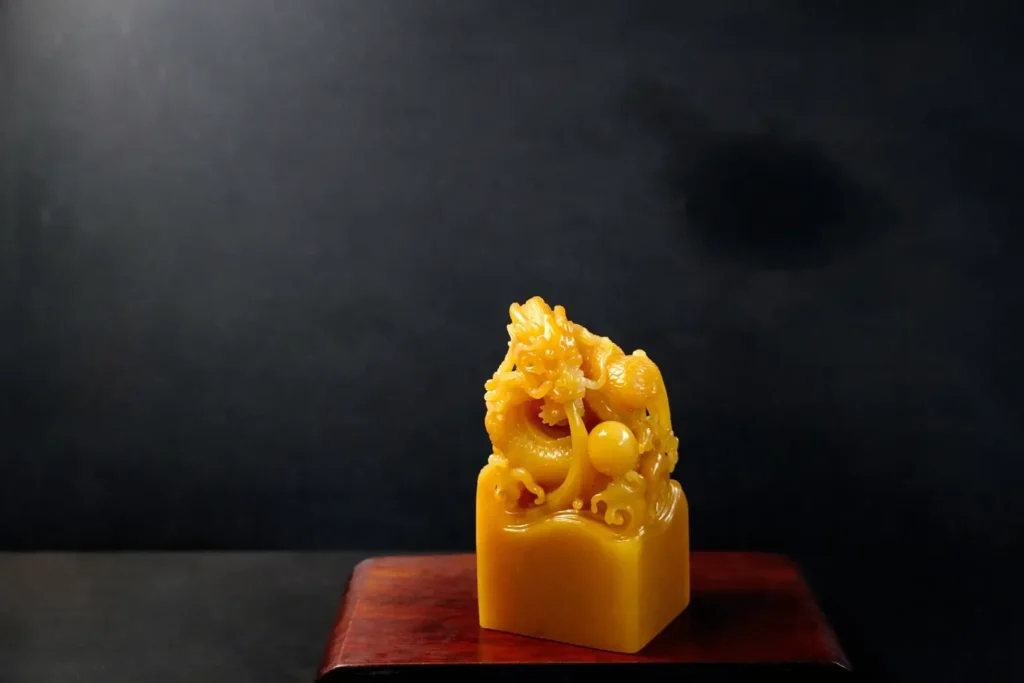
To the touch, Shoushan Furong is often compared to the “Silk of Stones.” Its physical properties distinguish it sharply from the harder, crystalline Rose Quartz, making it the premier choice for master carvers.
Texture and Luster: The Feel of Silk
Shoushan Furong is celebrated for its warm, gentle, and “moist” texture.
- The “Oily” Glow: Once polished, the stone exhibits a distinctive oily luster (greasy luster). Unlike the glass-like shine of quartz, Furong glows from within.
- The Patina Factor: With frequent handling and “play” (manual friction), the stone naturally develops a patina (Bao Jiang)—a silky, protective layer that deepens its glow and enhances its tactile smoothness over time.
- Carvability: With a Mohs hardness of only 3 (compared to Rose Quartz’s hardness of 7), Shoushan Furong is remarkably easy to carve. This softness allows artisans to execute incredibly intricate “fine-work” details that would be impossible on harder gemstones.
Classic Furong Stone Color Categories
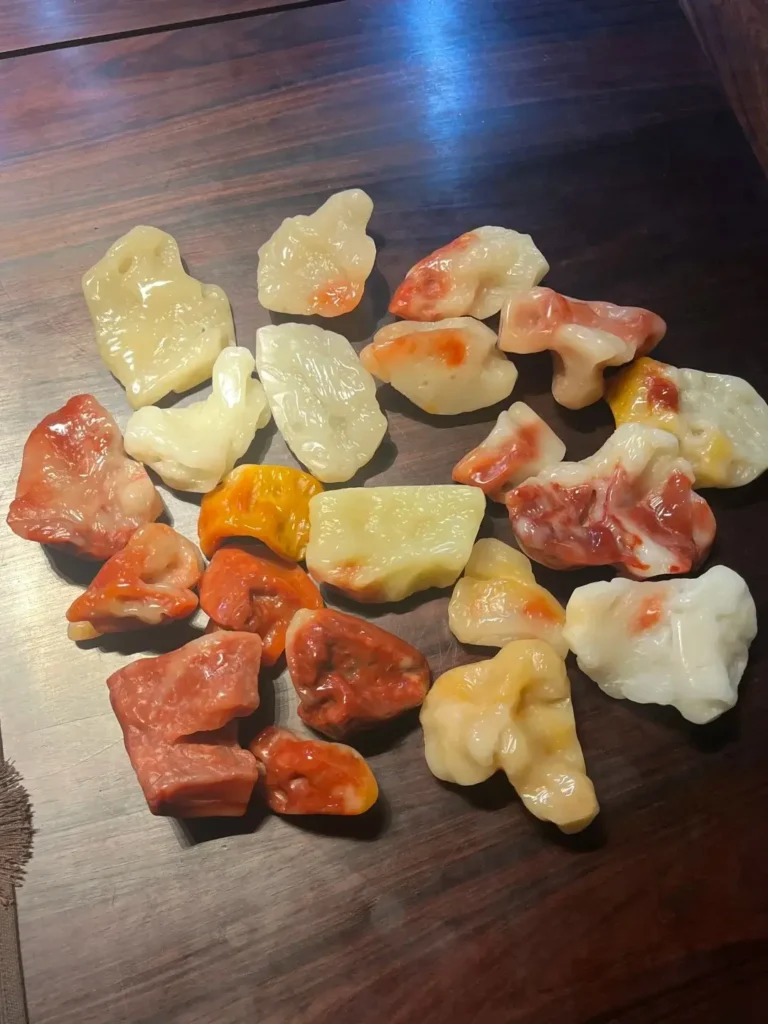
While white is the most iconic hue, Shoushan Furong offers a breathtaking palette that collectors categorize with poetic precision:
- The Whites (Primary Tones): The range includes Mutton-fat White, Porcelain White, and the legendary Lotus Root Tip White. The latter is the most prized for its crystalline, translucent purity, resembling the tender tip of a budding lotus root.
- Yellow Furong: Varieties such as Osmanthus Yellow and Beeswax Yellow offer bright, cheerful energy.
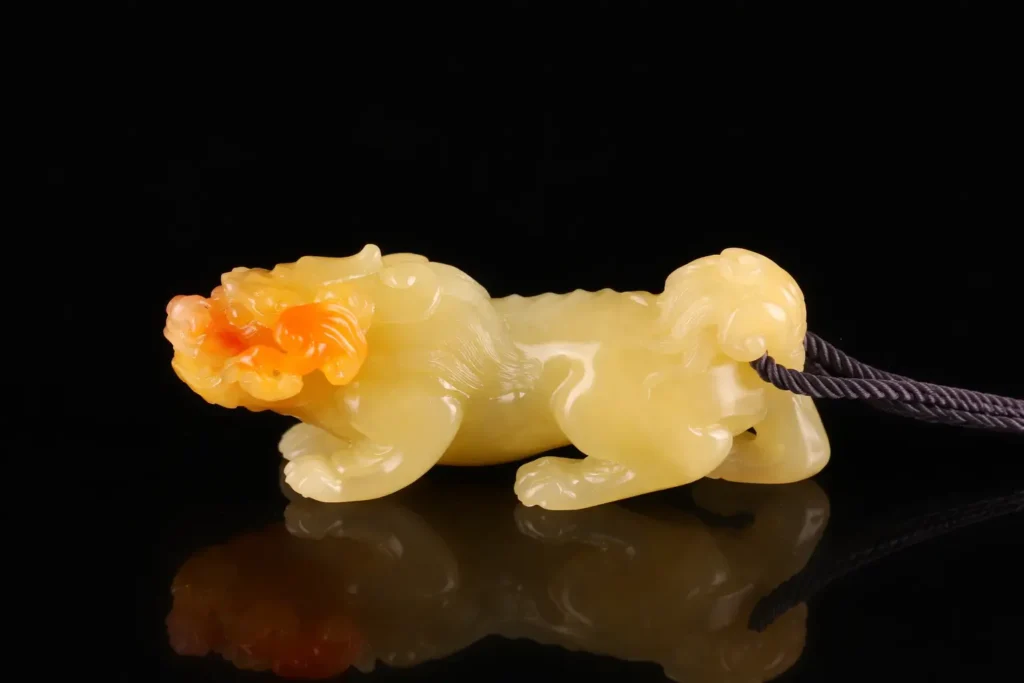
- Red Furong: This category features Candle Red (resembling freshly melted wax) and the famous Drunken Furong—a mesmerizing white-to-red gradient that evokes the blushing face of a legendary beauty.
- Five-Color Furong: These rare specimens feature a swirling fusion of multiple colors, mimicking the vibrant hues of a sunset.
Expert Note on Authenticity: High-quality Shoushan Furong often contains subtle, blocky “sand clusters” in shades of yellow, white, or gray. While these can challenge a carver, they serve as a natural anti-counterfeiting mark, helping experts distinguish authentic Shoushan origin from synthetic imitations.
Cultural and Investment Value of Shoushan Furong Stone
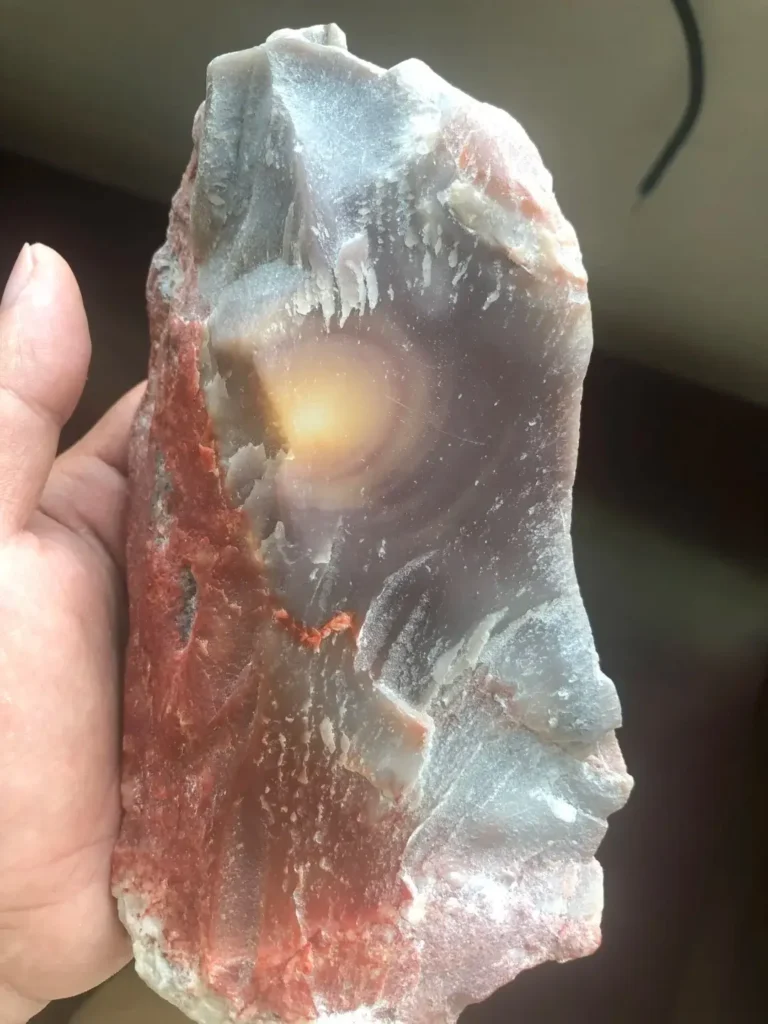
Shoushan Furong is not merely a beautiful object; it is a stable asset with deep historical roots.
1. Rarity, Exhausted Mines, and Scarcity
The most prestigious veins, such as the Jiangjun Dong (General’s Cave), have been completely exhausted for decades. Most “Old Mine” (Lao Liao) materials available today are precious relics from the Qing Dynasty. In contrast, newly mined materials often appear coarse and lack the buttery refinement of their predecessors, making high-quality pieces truly “one in a million.”
2. Market Stability and Long-Term Value Retention
Due to its stable pyrophyllite composition and its status as a finite resource, Shoushan Furong is highly resistant to market volatility. In modern auctions, top-tier White Furong stones frequently reach prices comparable to Tianhuang Stone (the “King of Stones”), with exceptional seals fetching millions of RMB ($150,000 – $500,000+ USD).
3. Imperial Seals, Scholars, and Historical Legacy
In Chinese culture, Shoushan Furong represents the scholar’s spirit. Qing Dynasty poetry often praised its beauty, stating, “Ice-like skin and jade-like wrists cannot compare to this stone; for true elegance, this must be the first rank.” Famous historical seals, such as Empress Dowager Cixi’s “Tong Dao Tang” seal, were carved from this very material, cementing its status as the “Stone Queen.”
2025 Market Prices for Shoushan Furong Stone
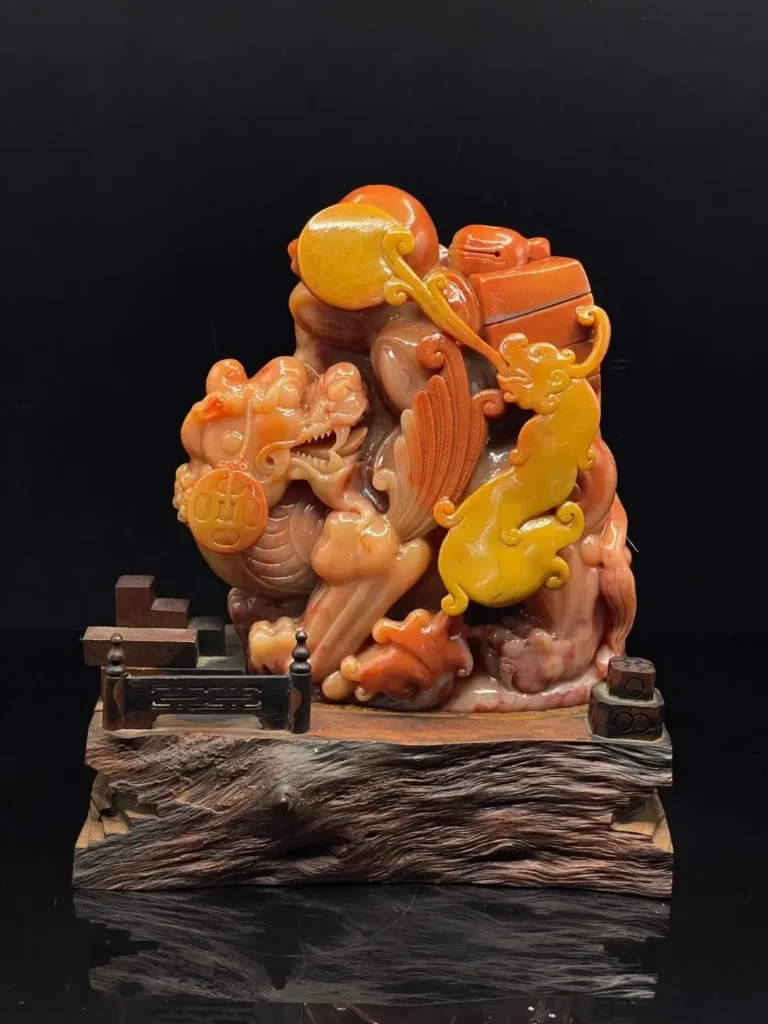
The market value of Shoushan Furong Stone varies greatly depending on material quality, carving craftsmanship, size, and historical provenance. With many premium mining veins largely exhausted, prices are expected to trend upward in 2026. The following overview provides a clear reference for collectors and investors on typical market ranges.
Entry-Level & Decorative
Approx. $35–$500 USD
This category includes small decorative objects and basic seals made from lower-grade material. These pieces may show uneven coloration or visible inclusions. While their investment potential is limited, they provide an accessible entry point for collectors interested in the distinctive “buttery” texture of Shoushan stone.
Premium / Investment Grade
Approx. $500–$5,000+ USD
Premium Shoushan Furong features higher purity, finer grain, and stronger oiliness. Stones in this tier often display desirable colors—such as high-quality red or white Furong—and are paired with refined carving craftsmanship. This segment represents the core market for serious private collectors and connoisseurs.
Museum-Grade & Historical
Tens of thousands to several hundred thousand USD
Top-tier pieces with confirmed historical provenance or carvings by renowned masters can reach tens of thousands to several hundred thousand USD, depending on rarity, historical importance, and auction conditions.
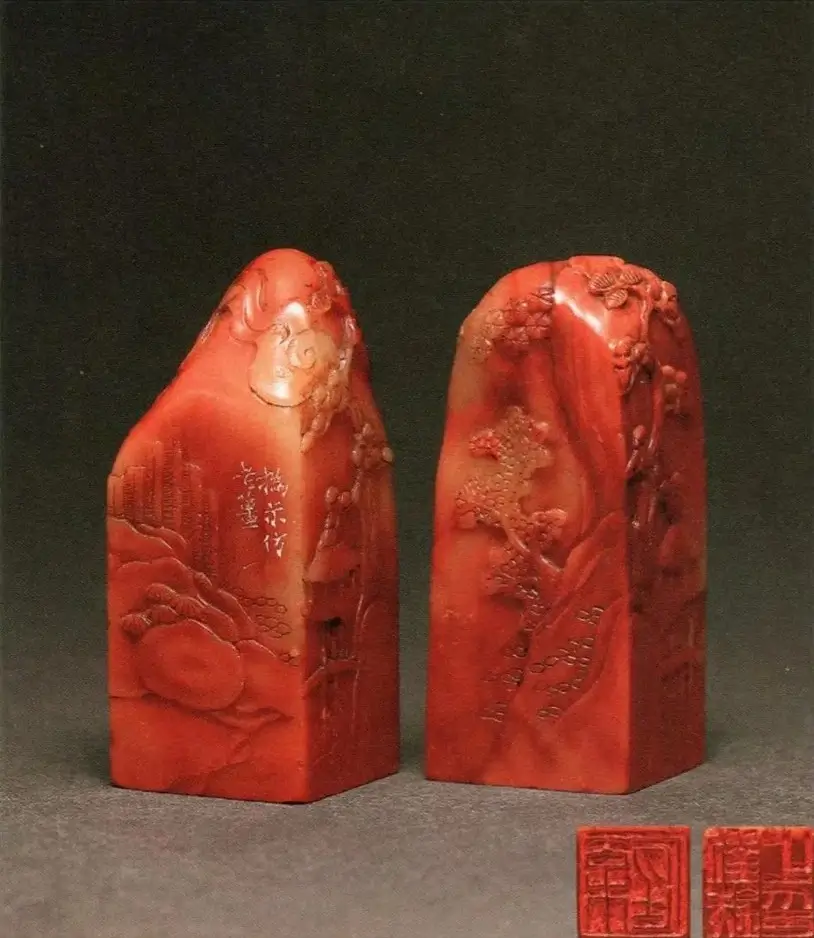
Example: The Liu Xian Pair
At the China Guardian 2023 Spring Auctions, a pair of Shoushan Furong seals associated with Liu Xian sold for RMB 1,840,000 (approximately $255,000–$270,000 USD), highlighting the premium placed on historical context and scholarly provenance.
How to Authenticate Shoushan Furong Stone
As supply continues to tighten and demand grows, imitation and misattributed “Furong-style” stones have become increasingly common. The following physical checks are widely used by experienced collectors and specialists.
1. Cross-Section and Cut Surface Examination
When inspecting a raw stone or the base of a seal, observe the cut surface carefully.
Authentic Shoushan Furong displays a flat, clean, and crisp cross-section with a refined internal structure. By contrast, imitations or non-Shoushan materials often show uneven, jagged, or irregular cuts that lack structural cohesion.
2. Internal Texture and “Stone Vein” Identification
True Shoushan Furong is prized for its purity and fine-grained, warm appearance.
- Authentic Material: Clean, compact texture with a soft, jade-like warmth
- Common Red Flag: Long, fibrous “stone veins” or string-like patterns often seen in inferior soapstone or synthetic substitutes
While genuine Furong may contain small, blocky sand clusters, it should never display coarse, linear fibers that disrupt its smooth internal character.
Final Thoughts: Market Outlook and Collecting Perspective
Shoushan Furong Stone holds a unique position in the Chinese seal-stone tradition. Because elite mining sites such as Jiangjun Dong have been fully exhausted, high-quality material is no longer a renewable resource. Instead, it has become a finite cultural asset.
As a result, top-tier Furong Stone continues to show strong value retention and long-term collectibility. Scarcity, historical pedigree, and material quality now matter more than ever.
For collectors, informed acquisition is essential. A clear understanding of material structure, historical context, and authentication standards allows buyers to navigate an increasingly selective market with confidence.
At the same time, Furong Stone reminds us that true value goes beyond price. From the gentle glow of Rose Quartz Furong Stone to the buttery elegance of Shoushan Furong, each variety reflects a balance of beauty, craftsmanship, and cultural meaning.
This philosophy guides the work of PeonyJewels. We focus on thoughtfully selected gemstones, custom jewelry designs, and original handmade vintage earrings—created to highlight natural texture, subtle color, and timeless form.
Whether you seek a custom gemstone piece with personal meaning or a one-of-a-kind vintage-inspired earring, we invite you to explore jewelry made with knowledge, care, and lasting intent.
✨ Discover meaningful adornment at PeonyJewels, where stones are chosen with understanding and designs are made to endure.