Moissanite vs. Diamond: Why They Are Optically and Physically Distinct
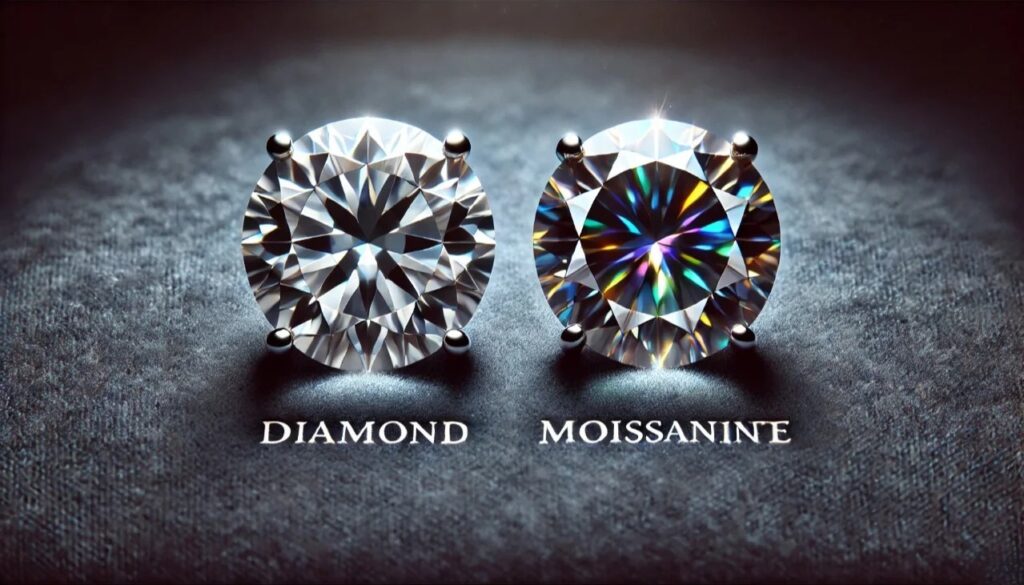
Despite their similar appearance, the Moissanite vs Diamond Optical Differences mean these two stones behave very differently under light—and those distinctions become obvious once you know what to look for.
While many couples now choose Moissanite (starting under $100) as a pragmatic, eco-friendly alternative, traditionalists still view Diamonds as the ultimate enduring legacy. Both choices are valid, but they are never truly identical. Beyond the price tag, these stones possess fundamentally different “DNA.”
In this guide, we examine the real moissanite vs diamond optical differences—from chemical structure to light performance—so you can choose with clarity, not assumption.
1. Hardness: Similar, But Not Equal
Diamond sits at the absolute top of the Mohs scale with a hardness of 10, making it the hardest natural substance known.
Moissanite follows closely at 9.25, which is still exceptionally hard by jewelry standards.
Practical identification:
A diamond can scratch moissanite, but moissanite cannot scratch a diamond.
In daily wear, both stones are durable. However, from a gemological standpoint, diamond remains unmatched.
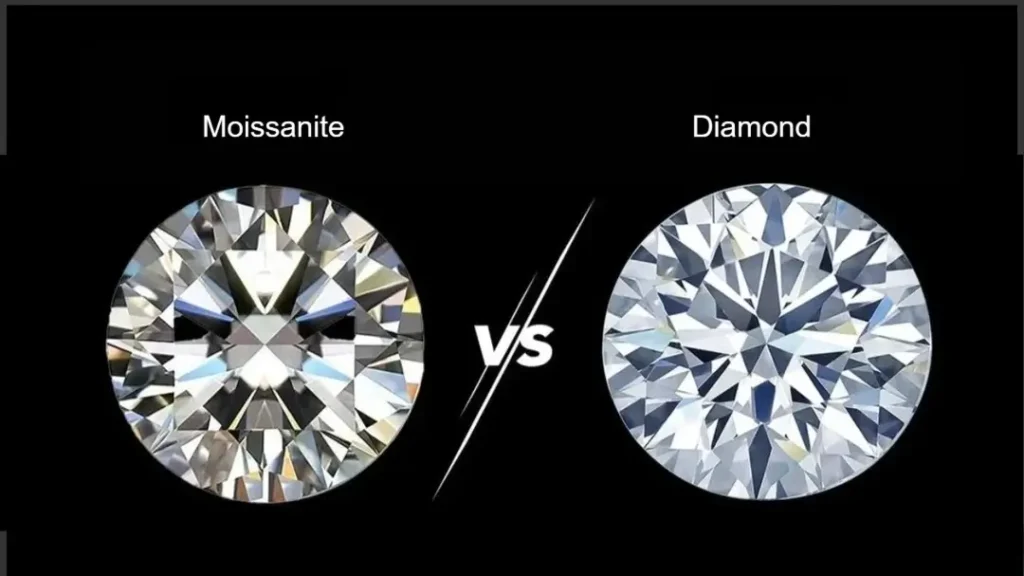
2. Fire and Dispersion: Moissanite vs Diamond Optical Differences in Sparkle
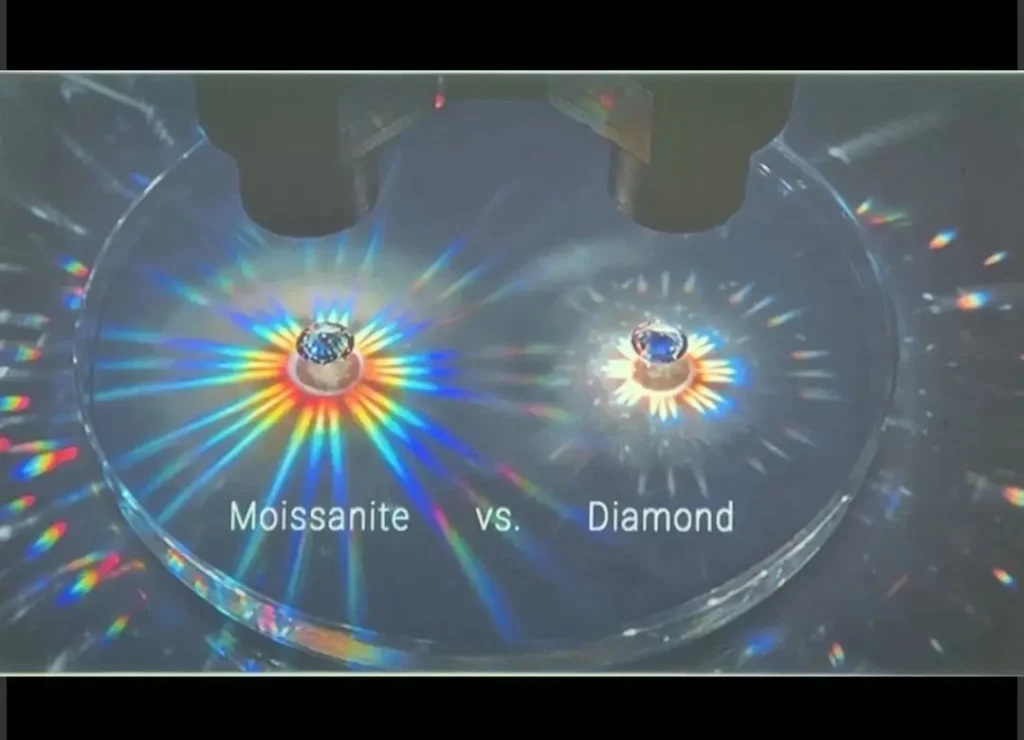
Diamond has a dispersion value of 0.044.
Moissanite’s dispersion is much higher at 0.104—over 2.5 times stronger.
This means moissanite produces significantly more rainbow flashes under light.
What this looks like in real life:
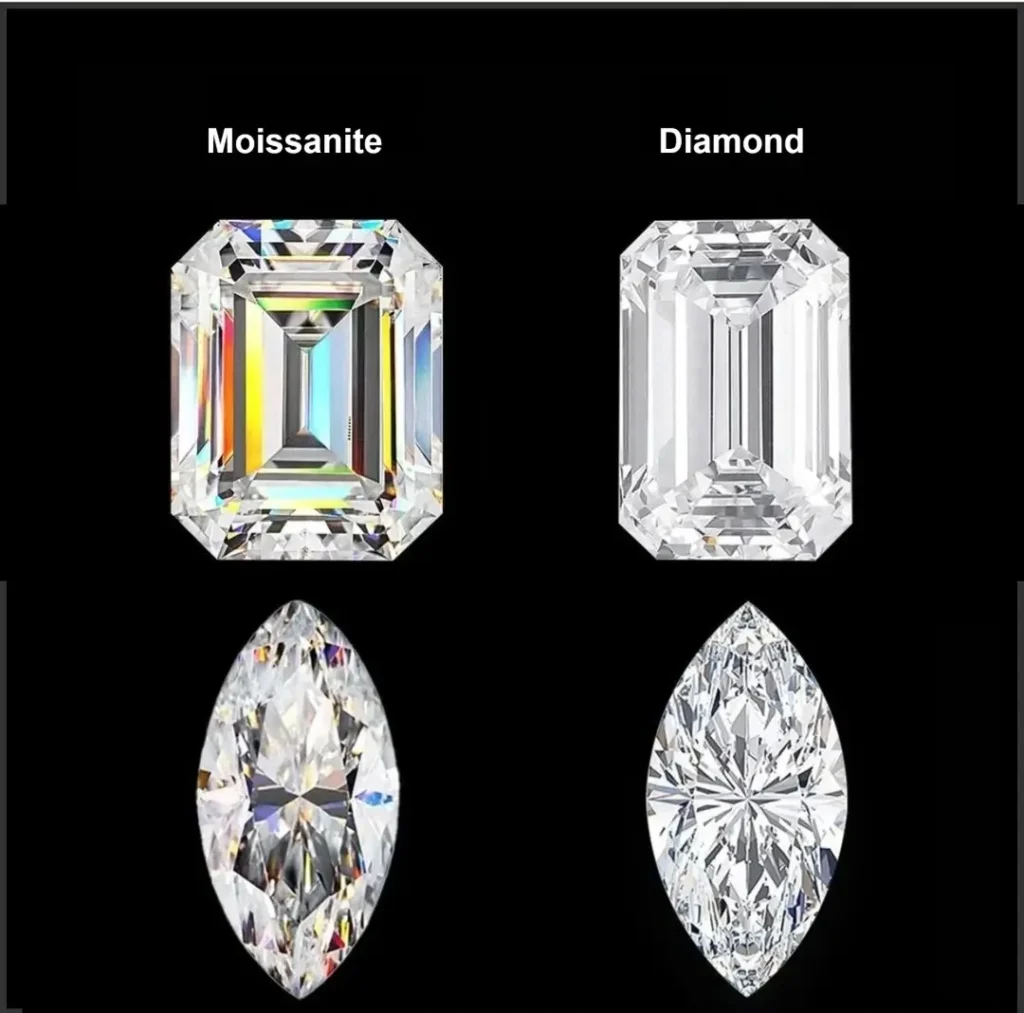
- Moissanite displays intense, colorful fire—often with a warm orange or yellow tone.
- Diamond’s fire is sharper, cleaner, and more restrained. It sparkles, but never looks “flashy.”
This effect becomes more obvious as size increases, which is why 1-carat moissanite is the most popular size—beyond that, the optical difference becomes instantly recognizable.
3. Electrical Conductivity: A Key Testing Difference
According to the GIA, approximately 80% of moissanite is electrically conductive.
By contrast, electrical conductivity in diamonds is extremely rare and occurs mainly in Type IIb blue or blue-gray diamonds.
Common white or light yellow diamonds are not conductive.
Identification method:
Professional gem testers can easily distinguish moissanite from diamond using electrical conductivity tests.
4. Chemical Composition: Fundamentally Different Materials
- Diamond is pure carbon (C), a crystalline form of graphite.
- Moissanite is silicon carbide (SiC), a compound not found naturally in gemstone quality.
They may look similar to the untrained eye—but chemically, they are entirely unrelated.
5. Refractive Index and Double Refraction
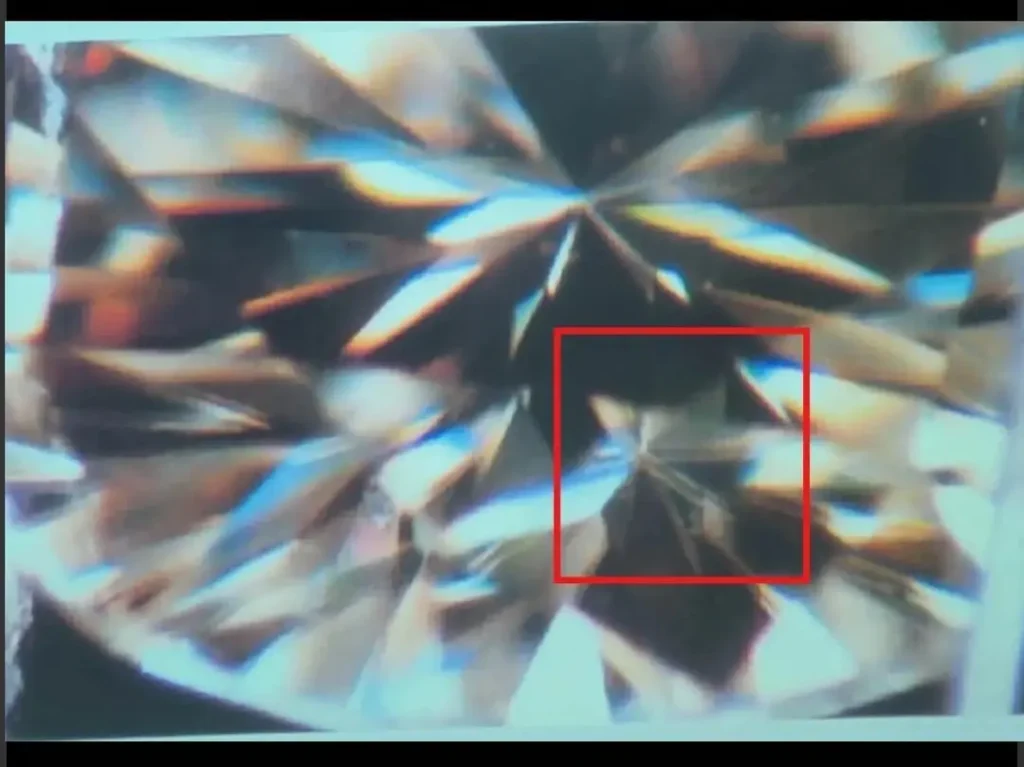
Moissanite has double refraction, meaning light splits as it travels through the stone.
What this means visually:
Under magnification, you may see:
- Duplicated facet edges
- A “double” effect at the pavilion or culet
Diamonds are singly refractive, producing crisper, more defined facet lines.
To some buyers, this perfection can actually feel less natural. Because it is lab-produced, defects can be easily eliminated.
Natural diamonds, however, are formed deep within the earth—once mined, inclusions cannot be undone. That natural origin is precisely what gives diamonds their individuality and long-term value.
6. Inclusions: Telling Internal Clues
Moissanite typically contains:
- Needle-like inclusions
- Fine, parallel reflective lines
Diamond inclusions vary widely and are rarely parallel in structure. These internal patterns are often key identification markers for gemologists.
7. Cutting and Polishing Habits
Moissanite can be polished continuously in one direction, resulting in parallel polishing lines along the girdle.
Diamonds require frequent direction changes during polishing due to their crystal structure. As a result:
- Adjacent diamond facets often show different polishing directions
- This difference is especially noticeable under magnification
8. Specific Gravity: Measurable Weight Difference
For loose stones, density testing provides another clear distinction:
- Diamond: 3.52
- Moissanite: 3.22
Colored Moissanite vs. Colored Diamonds
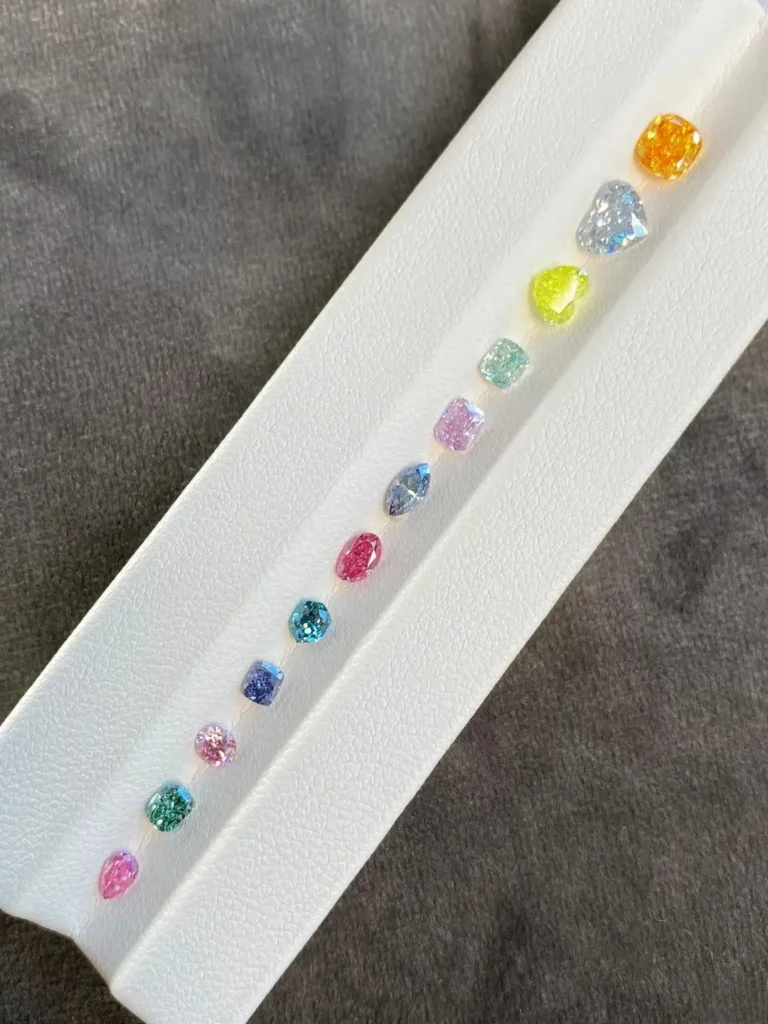
Moissanite rarely imitates natural fancy-colored diamonds.
Most colored moissanite on the market is surface-coated:
- Colors appear muted or grayish
- Coatings can wear off, fade, or change over time
Some buyers report noticeable fading after just a few years.
Natural fancy-colored diamonds, by contrast:
- Derive color from crystal structure or trace elements
- Maintain color permanently
- Are extremely resistant to wear
Coating is not unique to moissanite—it is widely used across many gemstones, including diamonds, sapphires, emeralds, topaz, and jade. However, coatings should always be disclosed.
Belgian Star Moissanite vs. Natural Diamond: A Visual Comparison
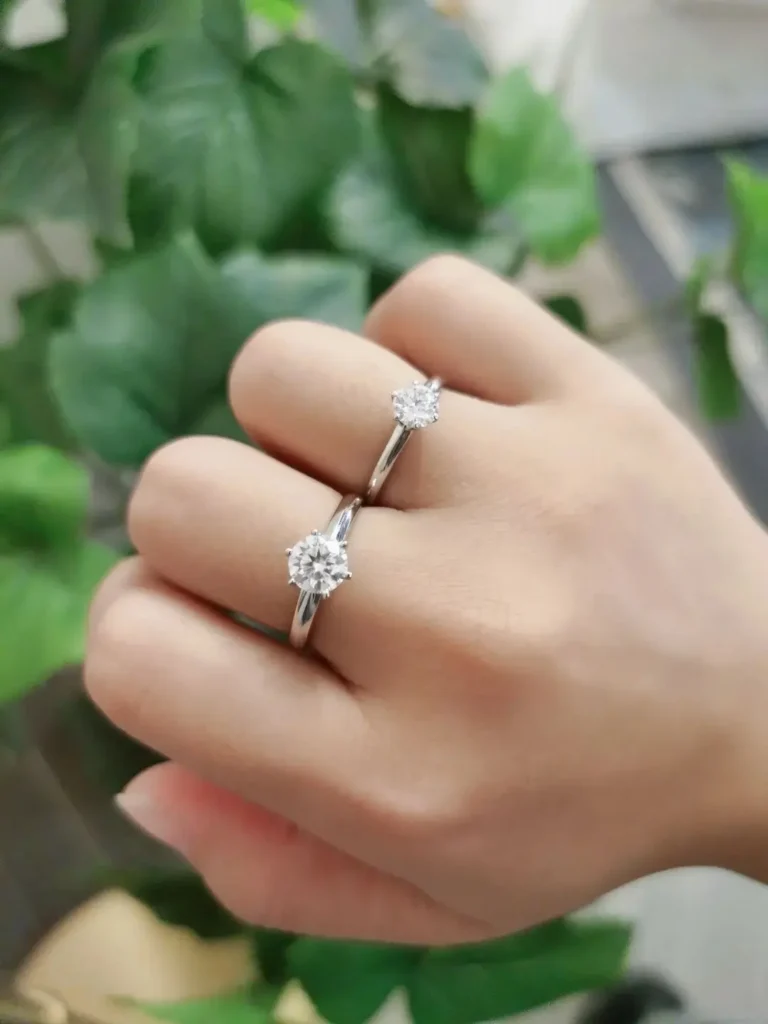
Right: 0.60ct Natural Diamond (D/VVS/3EX) in 18K Gold
Among moissanite varieties, Belgian Star Moissanite is often regarded as one of the closest to D color standards within the moissanite category.
Thanks to advanced cutting and optical control, it has largely overcome the traditional yellow tint associated with moissanite and is now accepted as a top-tier alternative within its category.
- 1-carat Belgian Star Moissanite: USD $600–$700 (retail)
- Comparable top-tier natural diamond (1ct, Triple Excellent, GIA-certified): USD $12,000+
Most moissanite on the market remains lab-produced and typically costs less than 1% of an equivalent diamond.
Diamond vs. Moissanite: Price Comparison
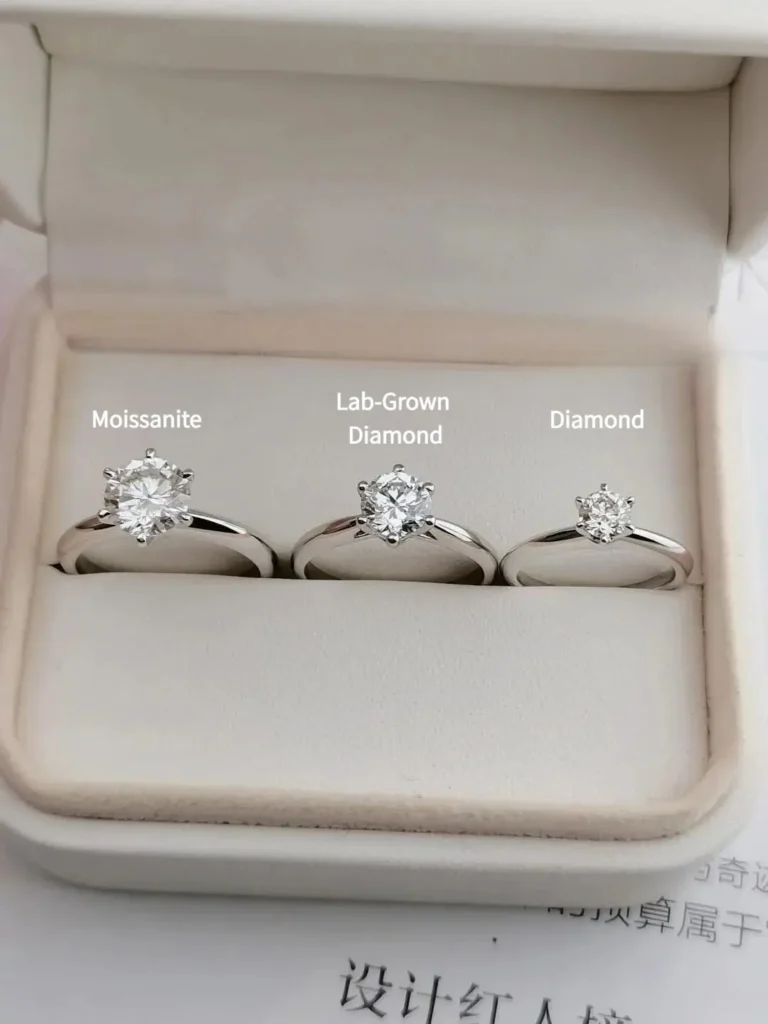
Natural Diamond (1 ct)
G color · VS clarity · Triple Excellent · No fluorescence · GIA
→ ~USD $6,000–7,000 (retail)
Lab-Grown Diamond (1 ct)
Same specifications
→ ~USD $1,700–1,900 (retail)
Moissanite (1 ct, top grade)
→ ~USD $60–80 (retail)
While standard lab-grown moissanite can be found at lower price points (often around USD $15–20), premium top-grade stones offer superior color consistency and precision cutting. As manufacturing technology advances, the quality of moissanite continues to reach new heights, making top-tier brilliance more accessible than ever.
💎Technical Summary: Moissanite vs Diamond Optical Differences & Physical Properties
| Feature | Natural Diamond | Moissanite | Why It Matters |
|---|---|---|---|
| Chemical Formula | Pure Carbon (C) | Silicon Carbide (SiC) | Determines the “DNA” and origin of the stone. |
| Hardness (Mohs) | 10 | 9.25 | Diamond is the hardest; Moissanite is the 2nd hardest. |
| Refractive Index | 2.417 (Single) | 2.65 – 2.69 (Double) | Moissanite has more “glow,” Diamond has sharper edges. |
| Dispersion (Fire) | 0.044 | 0.104 | Moissanite has 2.5x more “rainbow” flashes. |
| Conductivity | Non-conductive | ~80% Conductive | Professional testers use this to tell them apart. |
| Specific Gravity | 3.52 | 3.22 | Moissanite is about 10% lighter than diamond. |
| Retail Price (1ct) | $6,000 – $7,000 | $60 – $80 | Moissanite costs less than 1% of a natural diamond. |
For a more detailed look at moissanite’s optical traits—and how professionals visually distinguish it from diamond—read our PeonyJewels blog guide: What Is Moissanite and How to Tell It Apart from Diamond?
Should You Choose Moissanite or Diamond for an Engagement Ring?
There is no universal right answer.
If you want:
- A symbolic ring for a single occasion
- Minimal cost
→ Moissanite is perfectly reasonable
If you want:
- A lifetime piece
- Long-term value
- Jewelry that can be passed down
→ Diamond remains unmatched
The right choice depends entirely on budget, intention, and personal values.
Expert Tips for Buying Moissanite Rings
If moissanite is your choice, use these expert tips to ensure your jewelry looks premium and intentional:
- Balance Size with Realism: Your choice of carat weight should match your style goals. If you want a true diamond look, stay under 1.00 carat to keep the “rainbow fire” subtle. If you prefer moissanite for its maximalist sparkle, feel free to go larger—just know the optical differences become more obvious as the size increases.
- Smart Metal Pairings: Since moissanite is budget-friendly, don’t overspend on the setting. Sterling Silver or Gold Vermeil offers a premium look and skin-safe durability without the high cost of 18K gold or platinum.
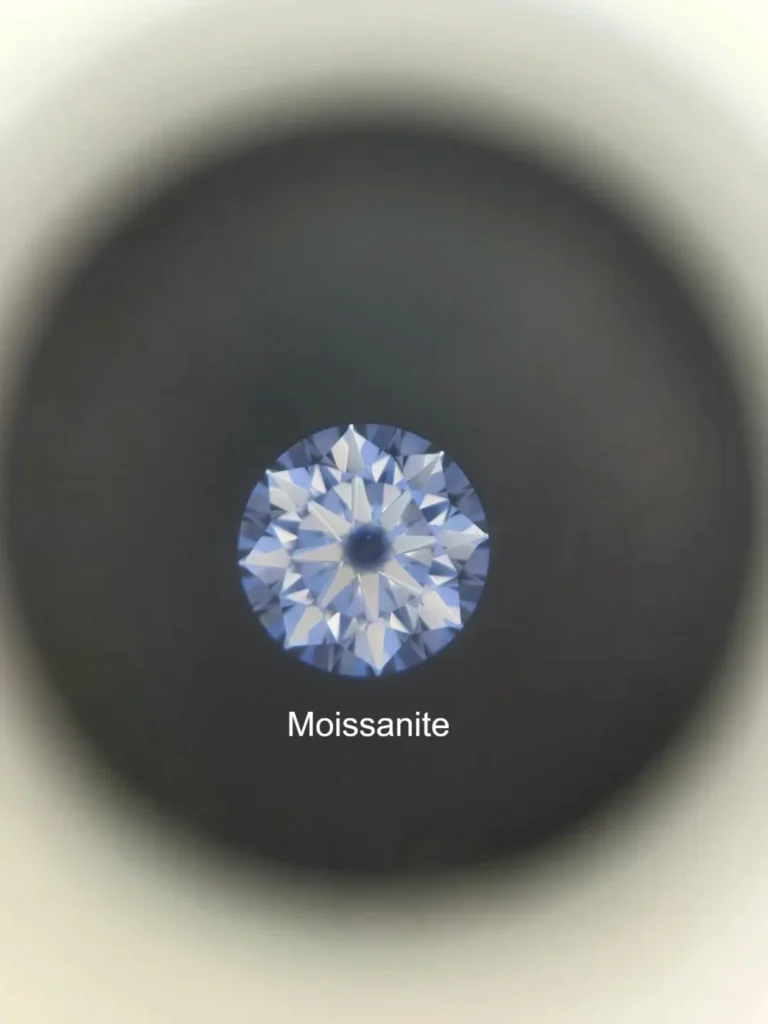
- Focus on the Cut: Always prioritize “Hearts and Arrows” or “Ideal” cuts. A precision cut minimizes the “fuzzy” effect of double refraction, giving your stone the sharp, clean facet lines found in top-tier diamonds.
Frequently Asked Questions: Moissanite vs. Diamond
1. Is moissanite a “fake” diamond?
No. Moissanite is a distinct gemstone made of silicon carbide. While it shares a similar brilliance with diamonds, its chemical “DNA” and optical properties make it a professional gemstone in its own right, not a diamond imitation.
2. Can you visually tell the difference?
To a trained eye, yes. Moissanite has 2.5 times more “fire” (rainbow flashes) than a diamond. This effect is especially noticeable in natural sunlight or for stones larger than 1.00 carat, where the colorful sparkle is more pronounced.
3. Does moissanite lose its sparkle or turn cloudy over time?
No—under normal wear, moissanite does not lose its sparkle or turn cloudy.
With a Mohs hardness of 9.25, it is highly resistant to scratching and chemical damage. Unlike cubic zirconia, which can degrade over time, moissanite retains its brilliance for decades with proper care.
4. Why is moissanite so much more affordable than diamond?
The price reflects its lab-grown origin. Because moissanite can be produced efficiently in a controlled environment, it costs significantly less than natural diamonds, which are finite and require extensive mining.
5. Is moissanite as durable as a diamond?
Almost. Diamond is the hardest material (10 on the Mohs scale), but moissanite (9.25) is the second-hardest gemstone used in jewelry. It is more than durable enough for daily wear and engagement rings.
6. Which is more eco-friendly?
Moissanite is widely considered the more sustainable choice. Being lab-created, it avoids the environmental disruption and ethical complexities often associated with traditional diamond mining.
Final Thoughts
Moissanite is not a diamond imitation.
It is a different gemstone with its own properties, strengths, and limitations.
Lab-grown diamonds—not moissanite—are the true alternative to natural diamonds.
There is no right or wrong choice.
Only the choice that fits your life, your budget, and your expectations.
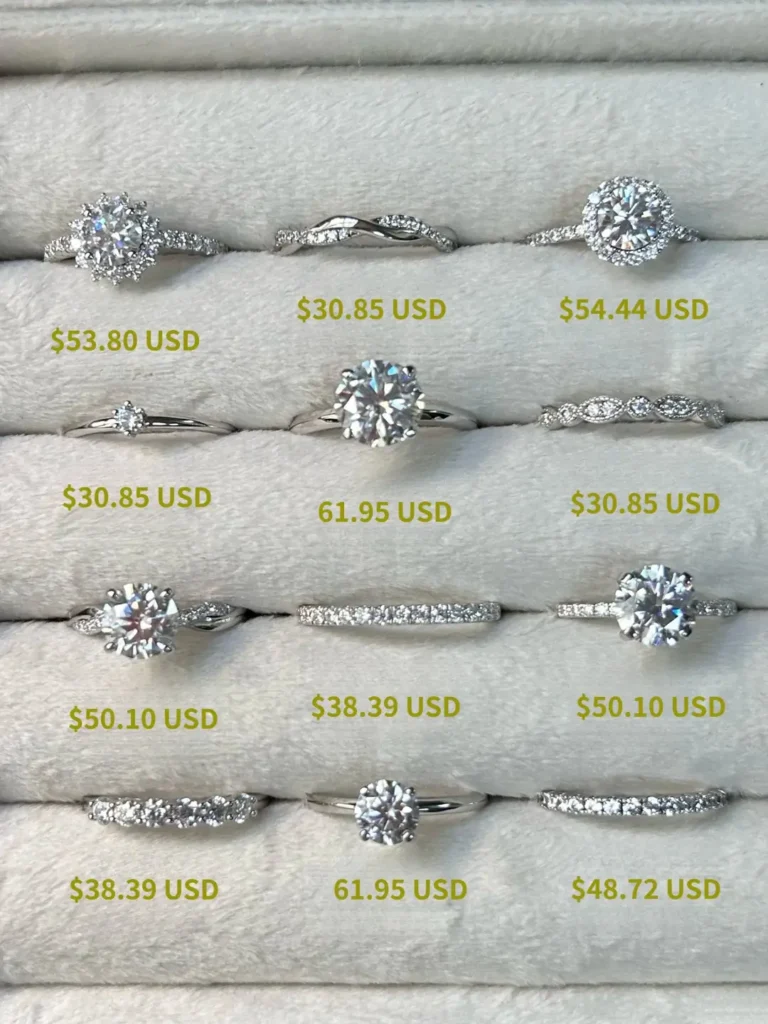
If branded diamond rings feel out of reach, PeonyJewels offers bespoke custom jewelry services, helping you balance craftsmanship, quality, and value. Beyond engagement rings, we also invite you to explore our original handmade vintage earrings, where timeless artistry meets modern design. Whether it’s a diamond or moissanite, your jewelry should reflect your story and your style.