Yellow Sapphire — The Golden Alternative to Yellow Diamonds
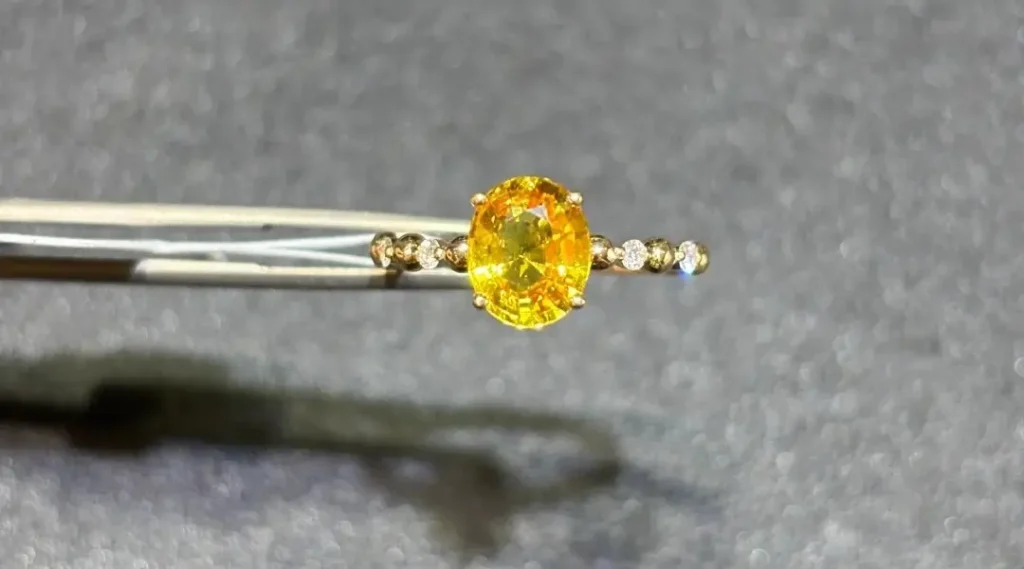
Golden diamonds are undeniably captivating, but their eye-watering price tags often place them firmly out of reach for many jewelry lovers. For those drawn to the golden glow of fine jewelry, Yellow Sapphire offers a far more practical—and surprisingly powerful—alternative. It delivers the same radiant warmth without the pressure of an investment-level purchase.
As a distinguished member of the corundum family, Yellow Sapphire delivers an exceptional balance of beauty and durability. With a Mohs hardness of 9, excellent natural clarity, and rich color saturation, it offers something yellow diamonds rarely do: impressive carat size at a fraction of the cost. For collectors and everyday wearers alike, this gemstone represents one of the smartest value choices in fine jewelry today.
To begin, let’s explore the most important factor in evaluating any yellow sapphire—its color.
Table of Contents
- Decoding the Color Grades of Natural Yellow Sapphires
- Light Yellow — The Soft Glow
- Yellow — The Classic Mid-Tone
- Intense Yellow — Deep & Saturated
- Vivid Yellow — The “Canary” Standard
- Orangish Yellow — Golden Warmth
- Yellow Sapphire vs. Yellow Diamond — A Practical Comparison
- Yellow Sapphire vs. Yellow Diamond Comparison
- What This Means for Everyday Wear
- Yellow Sapphire vs. Diamond: The Price Advantage
- Do Yellow Sapphires Fade? A Gemstone Insider’s Warning
- Yellow Sapphire Insider: My Near-Miss in the Gemstone Market
- The “Ghost” of a Gemstone
- The Reality of Unstable Color in Yellow Sapphires
- The Science of Color Stability: Why Do Some Yellow Sapphires Fade?
- How Do Yellow Sapphires Get Their Color?
- Iron (Fe³⁺): The Most Stable Coloring Agent
- Unstable Color Centers in Yellow Sapphire
- Chemical Impurities in Synthetic Yellow Sapphire
- Stable vs. Unstable Color — Why Some Yellow Sapphires Fade
- Stable Color: Natural or Thermally Enhanced
- Unstable Color: Irradiation-Induced Color Centers
- Beryllium Diffusion in Yellow Sapphire: What You Need to Know
- Why Fading Speeds Vary
- Final Takeaway on Yellow Sapphire Fading
- How Do Yellow Sapphires Get Their Color?
- Yellow Sapphire Certification: Why “No Heat” Doesn’t Guarantee Stability
- The Practical Limits of Laboratory Testing
- A Personal Lesson: When “Vivid Yellow” Turns Ghostly
- Yellow Sapphire Market Status & Expert Buying Advice
- Red Flags to Avoid
- Key Takeaway for Buyers
- Yellow Sapphire Buying Guide: Why Heated is Best Value
- The Visual Upgrade: From “Dusty Lemon” to “Liquid Gold”
- The Price Gap: Premium Size vs. Settling for Less
- Unmatched Stability: Beauty That Lasts Decades
- Watch Out for the “Invisible Trap”
- How to Evaluate the Quality of a Yellow Sapphire
- Evaluating Yellow Sapphire Clarity
- The Cut for Yellow Sapphires
- Carat Weight for Yellow Sapphires
- How to Care for and Clean Your Yellow Sapphire
- Protect from Physical Impact
- Shield from Harsh Chemicals
- Separate Storage
- Routine Cleaning
- Bring Your Golden Vision to Life with Peony Jewels
Decoding the Color Grades of Natural Yellow Sapphires
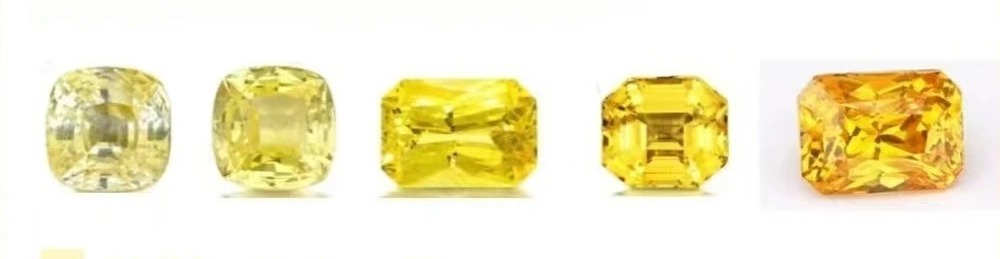
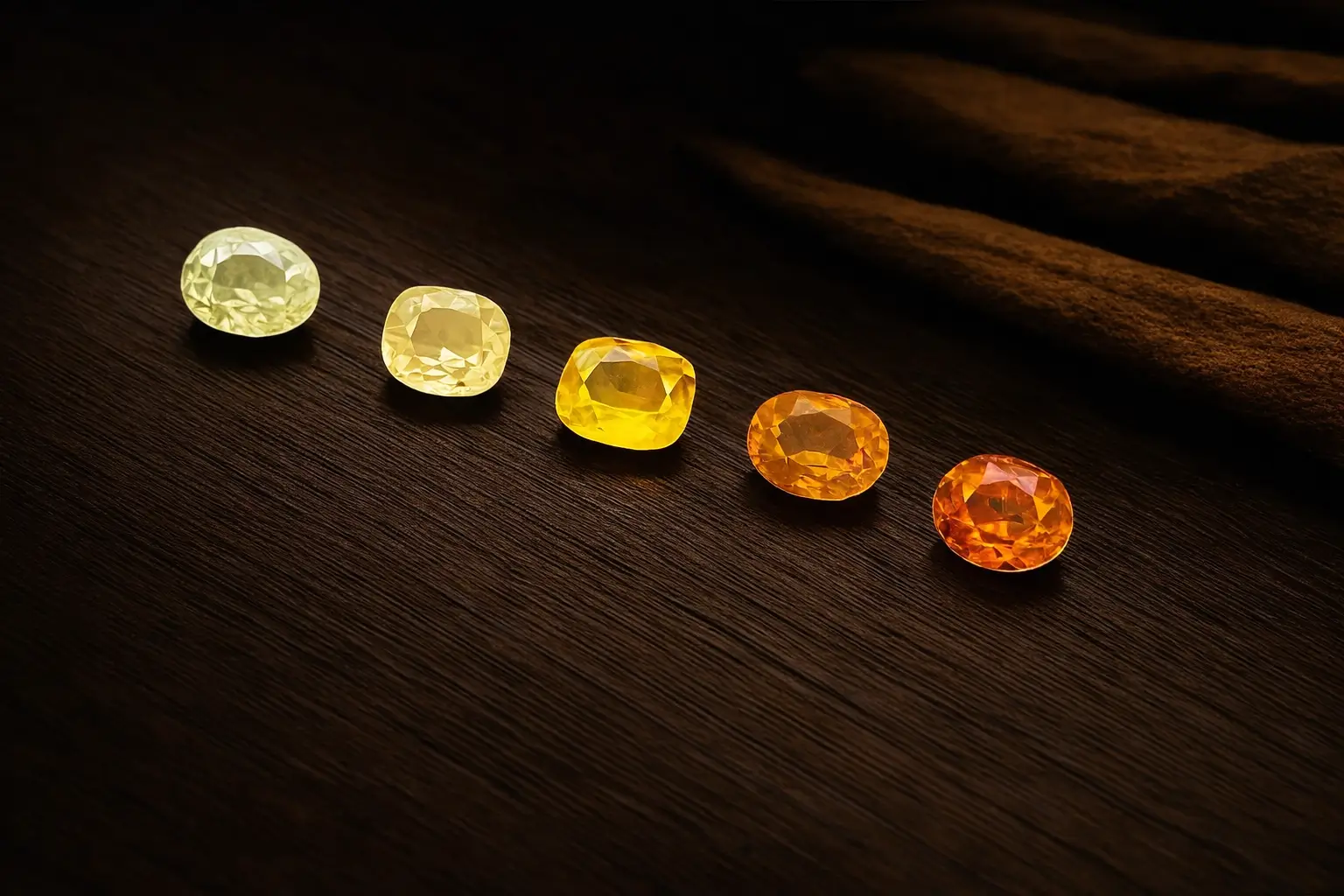
Unlike other sapphire varieties, Yellow Sapphire radiates a distinct sense of warmth and nobility that feels both luminous and refined. Its color spectrum ranges from soft, sunlit pastels to intensely saturated golden hues. Understanding these color grades is essential, as even subtle shifts in tone and saturation can dramatically affect beauty, rarity, and value.
Light Yellow — The Soft Glow
Light yellow sapphires feature a pale tint that borders on near-colorless transparency. The color feels airy and understated, offering a fresh, delicate aesthetic rather than bold saturation. These stones are ideal for lovers of quiet luxury and minimalist designs, where elegance is expressed through restraint rather than intensity.
Yellow — The Classic Mid-Tone
This is the most familiar and widely available shade of yellow sapphire. Balanced and cheerful, classic yellow presents a clean “lemon” hue that performs beautifully across different metal settings, from crisp white gold to warm yellow gold. Its versatility makes it a popular choice for everyday fine jewelry.
Intense Yellow — Deep & Saturated
Stepping into the high-end tier, intense yellow sapphires display noticeably higher saturation and depth. The color appears fuller and more commanding, producing a strong visual presence even in smaller stones. These sapphires are especially valued for their ability to maintain richness under various lighting conditions.
Vivid Yellow — The “Canary” Standard
At the top of the color hierarchy lies vivid yellow, often referred to in the trade as “Canary Yellow.” Exceptionally bright and pure, this color mirrors the striking feathers of its namesake bird. True vivid yellow sapphires are remarkably rare, and their scarcity places them among the most valuable stones in the yellow sapphire category.
Orangish Yellow — Golden Warmth
Some yellow sapphires lean toward warmer tones, blending yellow with distinct orange undertones. This orangish yellow coloration creates a rich, honey-like glow that feels energetic and sun-drenched. Compared to pure yellow, these stones offer a deeper warmth and a more dramatic presence, appealing to those drawn to bold, expressive color.
Yellow Sapphire vs. Yellow Diamond — A Practical Comparison
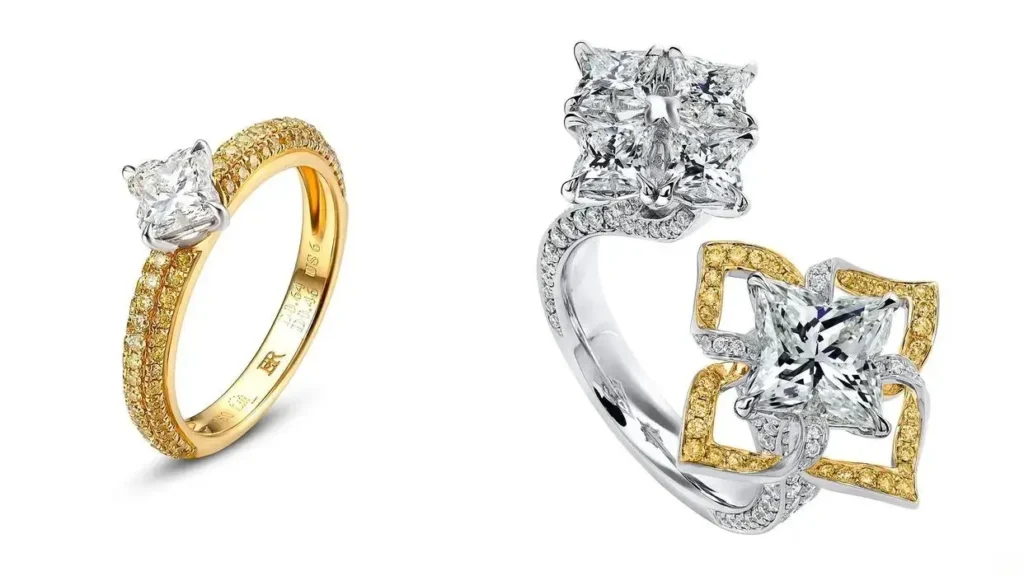
As demand for fancy color gemstones continues to rise, Yellow Sapphire has emerged as a compelling alternative to the yellow diamond—offering a similar sunlit brilliance with far greater accessibility.
While these two gemstones may appear visually alike at first glance, they belong to entirely different mineral families. Their differences in durability, light performance, rarity, and cost are precisely what make Yellow Sapphire such a strong value-driven choice. The comparison below highlights what truly sets them apart.
Yellow Sapphire vs. Yellow Diamond Comparison
| Feature | Yellow Sapphire | Yellow Diamond |
|---|---|---|
| Mineral Family | Corundum | Diamond (Carbon) |
| Mohs Hardness | 9 (Exceptional durability) | 10 (Maximum hardness) |
| Refractive Index | ~1.76 | 2.42 (High brilliance) |
| Crystal System | Trigonal | Isometric (Face-centered cubic) |
| Color Origin | Traces of iron and titanium | Nitrogen atoms replacing carbon |
| Luster | Vitreous (glass-like) | Adamantine (diamond-like) |
| Primary Sources | Sri Lanka, Madagascar, Thailand | Africa, Australia, India |
| Value Proposition | High (large carats, accessible pricing) | Premium (price increases exponentially) |
What This Means for Everyday Wear
Diamonds may sit at the top of the Mohs scale, but a Yellow Sapphire’s hardness of 9 already places it among the toughest gemstones used in fine jewelry. It is highly resistant to scratches and well suited for rings, pendants, and bracelets intended for long-term, daily wear.
In practical terms, the durability gap between a sapphire and a diamond matters far less than many buyers assume—especially outside of extreme conditions.
Yellow Sapphire vs. Diamond: The Price Advantage
This is where Yellow Sapphire clearly distinguishes itself.
In the diamond market, vivid yellow stones with eye-clean clarity become exponentially rarer as size increases. A 3–5 carat yellow diamond with strong saturation often enters six-figure territory.
Yellow Sapphires, by contrast, naturally occur in larger sizes with fewer inclusions. This allows buyers to own statement-scale gemstones—bold, luminous, and visually impressive—without the financial strain associated with diamonds. For collectors and designers alike, this balance of size, beauty, and cost is what makes Yellow Sapphire the undisputed value leader.
Do Yellow Sapphires Fade? A Gemstone Insider’s Warning
The world of Yellow Sapphires is more complex than it appears on the surface. Between natural unheated stones, traditional heat treatment, beryllium diffusion, and lab-grown synthetics, the market is a maze.
Generally, reputable dealers offer full transparency regarding treatments like diffusion. However, there is one particular phenomenon that keeps even seasoned gemstone professionals awake at night: The Fading Yellow Sapphire.
Yellow Sapphire Insider: My Near-Miss in the Gemstone Market
They say that “if you walk by the river often enough, you’re bound to get your shoes wet.” In the gemstone trade, we all pay our “tuition” through hard-earned lessons. Last year, while scouting at a prominent gem market, I encountered a breathtaking, unheated golden-yellow sapphire. Its saturation was hypnotic—the kind of “love at first sight” color that demands a premium price.
Because we couldn’t agree on the final figure, I reluctantly walked away. At the time, I was frustrated; looking back, I was incredibly lucky.
The “Ghost” of a Gemstone
Fast forward one month. I crossed paths with that exact same stone again. As an insider who spends every day looking at stones, I have a photographic memory for exceptional gems—their inclusions and silhouettes become etched in my mind.
But when I saw her again, I was shocked. The vibrant, majestic gold I had fallen for was gone. In its place was a pale, washed-out, and lifeless shadow of its former self. While the fading wasn’t as extreme as some “total transparency” cases I’ve seen, the loss of color was undeniable and devastating. It had lost its soul.
The Reality of Unstable Color in Yellow Sapphires
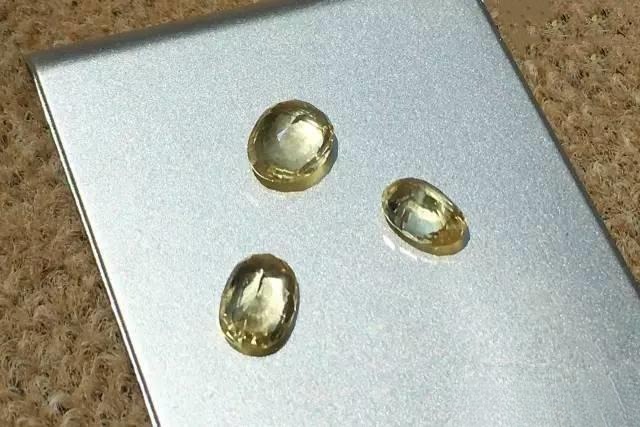
I have since encountered even more severe cases where a sapphire’s color literally vanishes, leaving behind a stone that looks almost colorless. While these experiences can be disheartening—and expensive if you are the one holding the stone—they are essential milestones in a gemstone professional’s growth.
This brings us to the most critical question for any collector: Why does this happen, and how can you protect yourself from buying a “temporary” color?
The Science of Color Stability: Why Do Some Yellow Sapphires Fade?
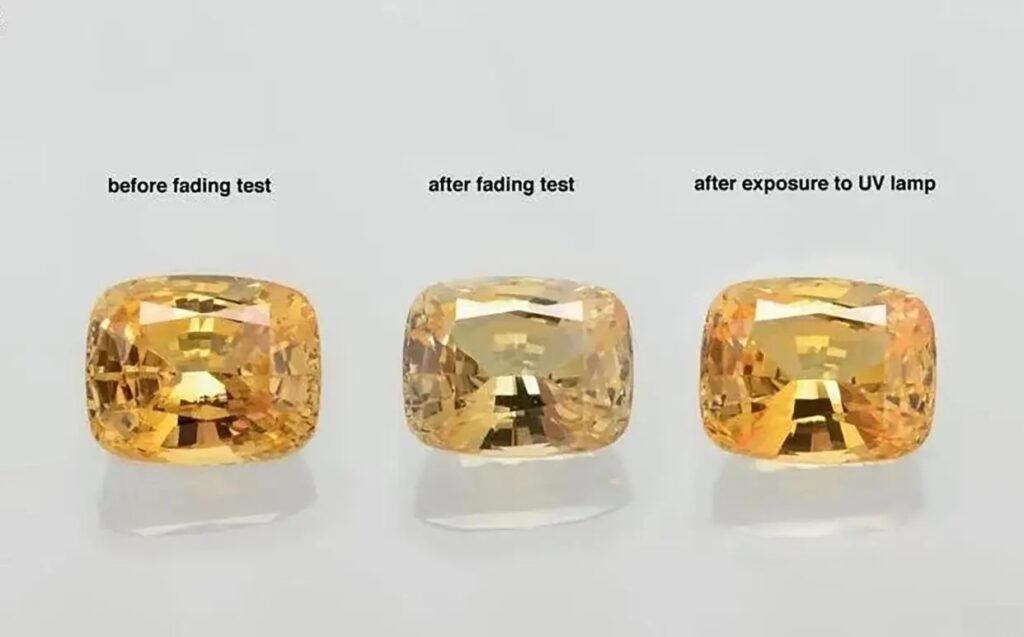
To understand why a Yellow Sapphire may fade over time, we must look beyond surface appearance and examine the gemstone’s atomic structure. Color in sapphire is not a surface coating—it arises from precise interactions between trace elements, lattice defects, and light. When those interactions are unstable, color loss becomes possible.
How Do Yellow Sapphires Get Their Color?
In natural and synthetic corundum, yellow coloration is most commonly associated with three distinct mechanisms:
1. Iron (Fe³⁺): The Most Stable Coloring Agent
Iron in its trivalent state (Fe³⁺) is the most widely accepted and stable cause of yellow coloration in natural sapphires. Its primary absorption band occurs around 450 nm. As iron concentration increases, both absorption intensity and bandwidth increase, producing deeper and more saturated yellow tones. Importantly, Fe³⁺-based coloration is generally stable under normal wear and light exposure.
2. Unstable Color Centers in Yellow Sapphire
Some yellow sapphires derive their color from color centers, specifically the pairing of a hole center (h•) with Fe³⁺. These microscopic lattice defects strongly absorb visible light, allowing even very low concentrations to produce vivid yellow hues.
This mechanism is especially common in acceptor-dominated sapphires, where divalent ions such as Mg²⁺ exceed tetravalent ions like Ti⁴⁺ and Si⁴⁺. During high-temperature heat treatment in an oxygen-rich environment (approximately 1200–1550°C), hydrogen diffuses out of the crystal. To restore charge balance, stable hole centers (h•) form and readily pair with existing Fe³⁺ ions.
When created under these conditions, h•–Fe³⁺ color centers are considered highly stable under normal sunlight and daily wear. Spectroscopically, this process is often accompanied by the weakening or disappearance of the FTIR OH absorption peak near 3161 cm⁻¹. Well-documented sources include Sri Lanka, Montana (Rock Creek), and Malawi.
3. Chemical Impurities in Synthetic Yellow Sapphire
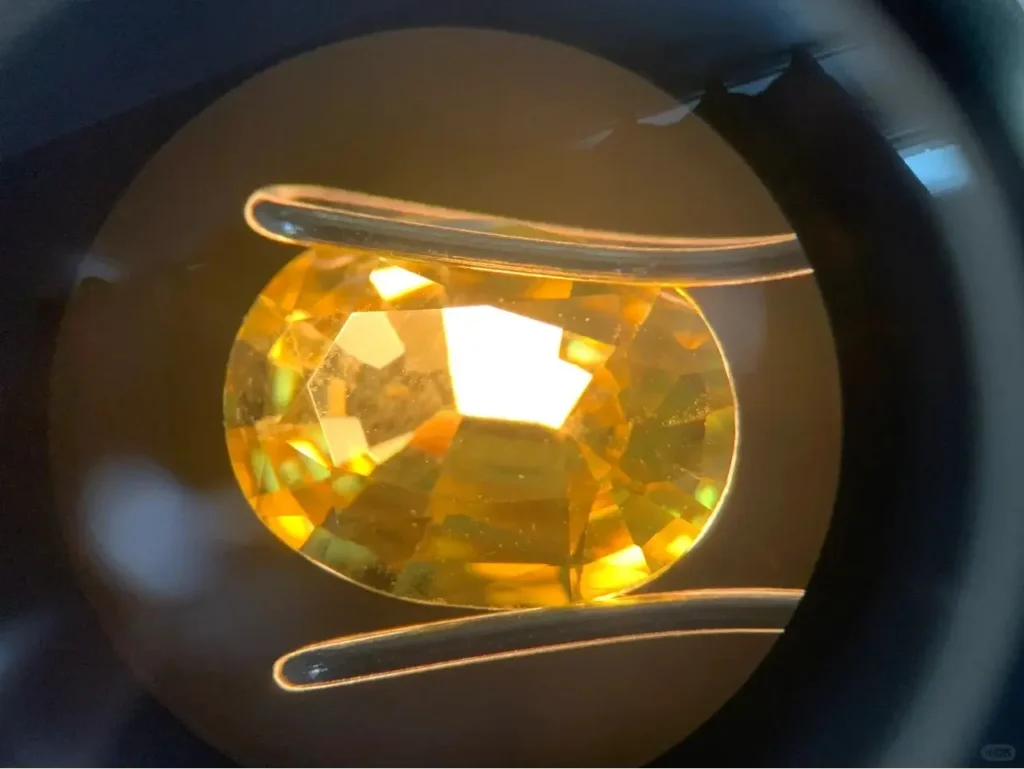
In synthetic yellow sapphires, coloration typically follows a different pathway. Elements such as Nickel (Ni³⁺)—sometimes in combination with Chromium (Cr³⁺)—are commonly introduced during crystal growth using methods like Verneuil or Czochralski. In some Ni-bearing Czochralski-grown stones, post-growth heat treatment can further stabilize or intensify the hue. These mechanisms are distinct from those found in natural sapphires.
Stable vs. Unstable Color — Why Some Yellow Sapphires Fade
The key factor behind fading is not color intensity, but color stability.
Stable Color: Natural or Thermally Enhanced
Yellow sapphires colored primarily by Fe³⁺ or by heat-induced h•–Fe³⁺ color centers tend to retain their color indefinitely under normal conditions. The color is structurally integrated into the crystal lattice and does not rely on fragile electronic traps.
Unstable Color: Irradiation-Induced Color Centers
Color centers can also be produced by radiation, either naturally during geological formation or artificially in a laboratory. Unlike heat-stabilized color centers, irradiation-induced centers are often metastable. Exposure to natural light or mild heat can release the trapped charge carriers, causing the color center to collapse and the sapphire to revert to its original pale yellow, greyish, or near-colorless appearance.
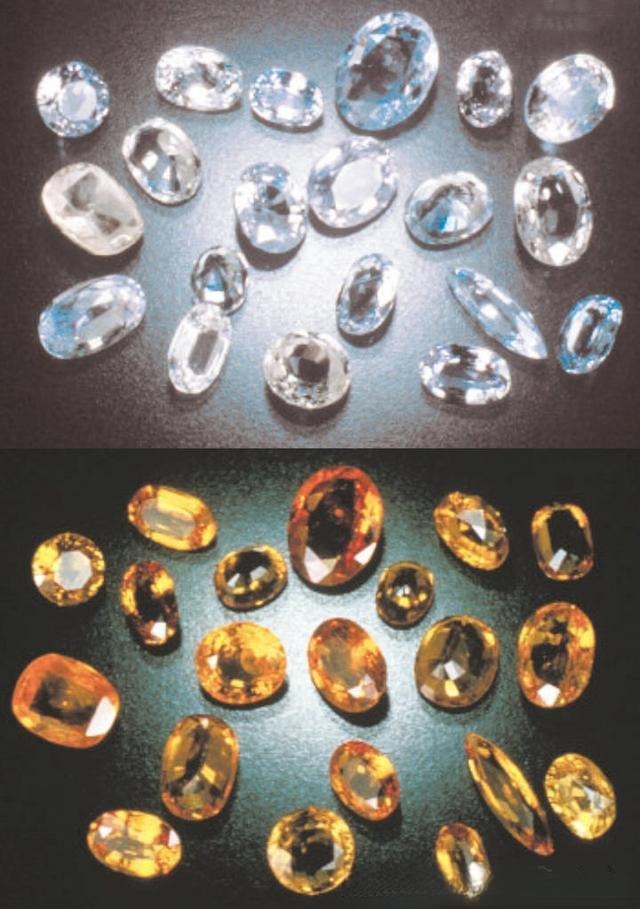
Key insight: The more dramatic the color enhancement produced by unstable irradiation, the more noticeable the eventual fading is likely to be.
Beryllium Diffusion in Yellow Sapphire: What You Need to Know
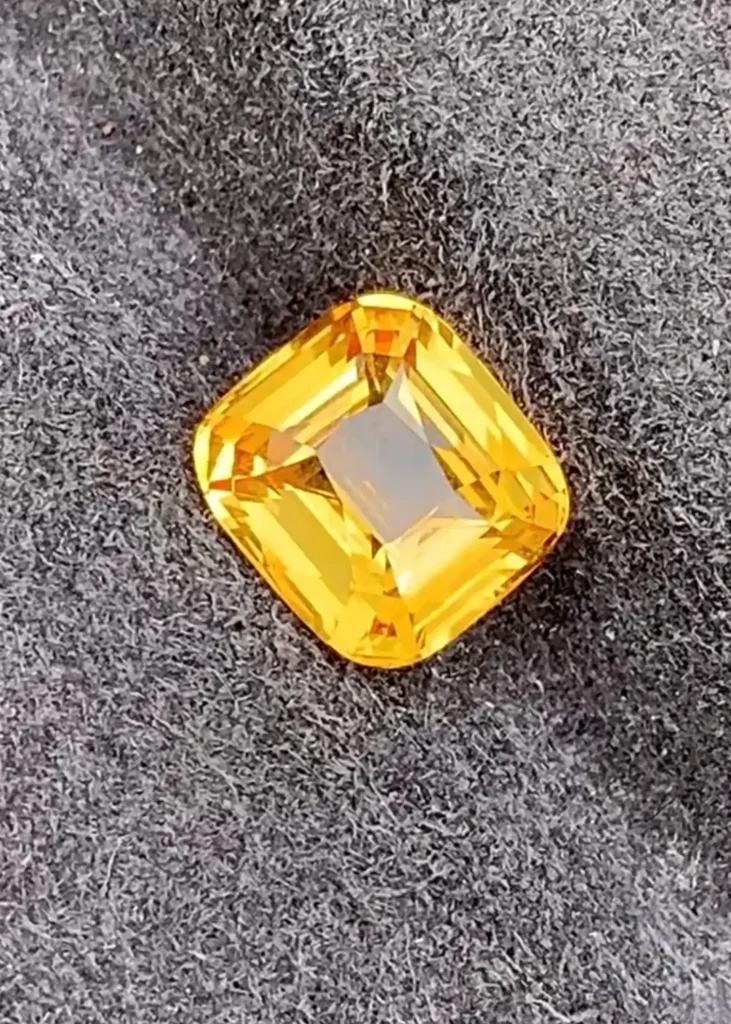
Beryllium (Be) diffusion must be clearly distinguished from fading phenomena. At extreme temperatures (approximately 1780–1800°C) in an oxygen-rich environment, beryllium atoms diffuse into the sapphire lattice, altering its charge balance and enabling the formation of intense yellow to yellow-orange hues through h•–Fe³⁺ pairing.
While the resulting color is permanent, this process fundamentally modifies the gemstone’s chemistry. As such, beryllium-diffused sapphires are classified as treated stones and typically carry lower market value than naturally colored or conventionally heated yellow sapphires. These treatments are detectable through advanced elemental and spectroscopic analysis.
Why Fading Speeds Vary
Not all unstable yellow sapphires fade at the same rate:
- Rapid fading: Some stones lose saturation within hours or days after mining or sun exposure.
- Gradual fading: Others may take weeks or months of regular light exposure before noticeable color loss occurs.
This variability reflects differences in the type and stability of the underlying color centers.
Final Takeaway on Yellow Sapphire Fading
When a Yellow Sapphire fades, the cause is rarely “poor quality” in a general sense. Instead, fading almost always points to unstable, irradiation-induced color centers, rather than iron-based or heat-stabilized mechanisms. Understanding this distinction is essential for collectors, jewelers, and buyers seeking long-term color stability.
Yellow Sapphire Certification: Why “No Heat” Doesn’t Guarantee Stability
While atomic science clearly explains the role of color centers, gem professionals find it far more difficult to identify them in a commercial setting. In the gemstone world, buyers often revere a ‘No Indication of Thermal Treatment’ certificate as the ultimate standard of authenticity. However, when evaluating Yellow Sapphires, relying solely on this designation can lead to costly misunderstandings.
The reason lies in the industry’s most persistent challenge: irradiation.
The Practical Limits of Laboratory Testing
Gemological laboratories are exceptionally reliable at detecting heat treatment. By examining internal features—such as altered inclusions or tension halos—labs can confidently determine if a stone has been heated.
Irradiation, however, is an invisible process. Unlike heat, it rarely leaves diagnostic internal footprints detectable by standard microscopic examination. This creates a critical loophole: a sapphire can be artificially irradiated to a vivid yellow and still receive a report stating: “No Indication of Heating.” While the certificate is technically accurate, it remains silent on whether the stunning color is permanent or temporary.
A Personal Lesson: When “Vivid Yellow” Turns Ghostly
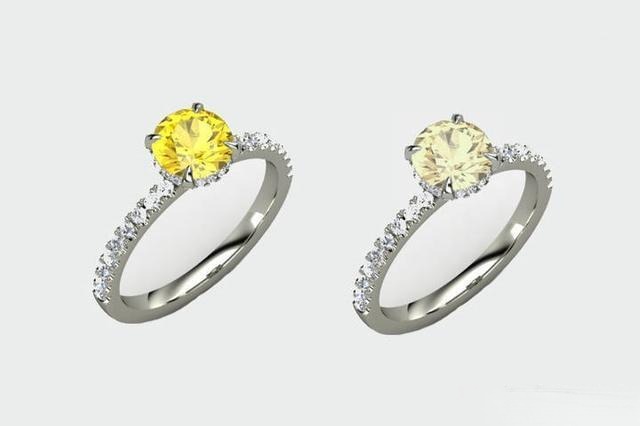
I learned the danger of this loophole firsthand. Last year, I acquired a “Vivid Yellow” unheated sapphire. It was hypnotic—saturated, glowing, and backed by a reputable lab report confirming no heat. I believed I had found a rare treasure.
Several months later, I took the stone out of my safe to show a client and was shocked. The once-regal, vibrant gold had faded into a pale, washed-out shadow, leaving only a whisper of yellow behind.
The certificate wasn’t wrong—the stone hadn’t been heated—but it was irrelevant. Its beauty was built on an unstable, irradiated foundation. Even for experienced professionals, this serves as a reminder: Certification of “No Heat” does not guarantee long-term color stability.
Yellow Sapphire Market Status & Expert Buying Advice
Understanding the market reality is essential for buyers:
- Heated (Industry Standard): The vast majority of yellow sapphires are heat-treated. This stable, globally accepted process deepens pale hues into vibrant, beautiful colors. Heated stones offer the best value: superior color, better clarity, and guaranteed long-term stability.
- Unheated (High-Risk Rarity): Truly natural, unheated sapphires with vivid “Canary Yellow” hues are extremely rare and often priced similarly to top-tier blue sapphires. Most unheated stones appear much paler, and their color may fade over time, especially if they were enhanced by irradiation.
Red Flags to Avoid
To protect your investment, watch out for these critical signs on lab reports:
- Beryllium Diffusion (Labeled as “Diffusion”): Produces a vivid surface color that can wear off with scratching, creating an artificial appearance. This is a chemical modification rather than a natural enhancement, which reduces the gem’s value.
- Irradiation (Labeled as “Irradiated”): While some labs can detect this treatment, many cannot. Irradiated yellow sapphires may exhibit intense color initially but fade rapidly under sunlight or normal wear. Exercise caution with unheated stones showing “too-perfect” yellow without a verified history of color stability.
Key Takeaway for Buyers
For most buyers seeking long-term value, heat-treated Yellow Sapphires are the most reliable choice. Unheated stones with exceptional yellow are beautiful but carry higher risk—both financially and aesthetically. Always consider color stability alongside lab certification and price before making a purchase.
Yellow Sapphire Buying Guide: Why Heated is Best Value
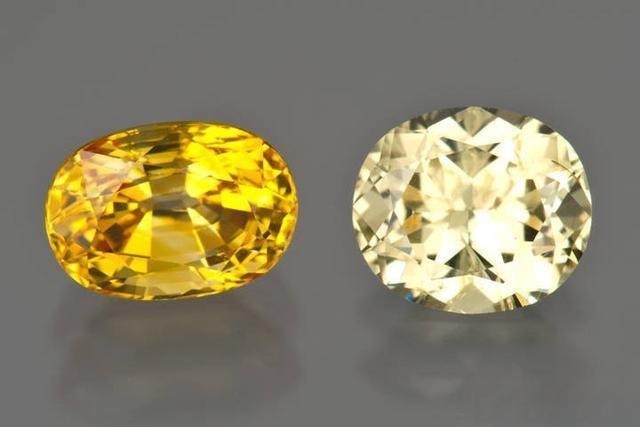
Don’t let the “Unheated = Better” myth hijack your budget. As we have seen, unheated Yellow Sapphires often carry hidden risks due to unstable color caused by irradiation. For most collectors, traditional heat treatment—often called “Old Heat”—offers the best combination of beauty, stability, and value. Here are three truths that will save you money and frustration.
1. The Visual Upgrade: From “Dusty Lemon” to “Liquid Gold”
Unheated Yellow Sapphires often appear pale, muted, or slightly greyish—like a lemon dusted with ash. Traditional low-temperature heating transforms a dull, watery tint into a rich, transparent “Royal Gold.” Under sunlight, a heated sapphire flows with molten brilliance, and its fire can appear three times more vivid than an unheated counterpart. This enhancement is fully recognized in the international jewelry industry, not classified as a deceptive treatment, and is clearly disclosed on reputable certificates.
2. The Price Gap: Premium Size vs. Settling for Less
Unheated Yellow Sapphires carry a steep price premium. A 1-carat, eye-clean unheated stone can cost two to three times more than its heated equivalent. For buyers on a budget, pursuing unheated stones often means compromising on carat weight or clarity. Choosing a heated sapphire allows you to acquire a larger, high-clarity “statement stone” without overspending.
3. Unmatched Stability: Beauty That Lasts Decades
Heated Yellow Sapphires excel in long-term stability. Once enhanced at high temperatures, their color and clarity remain consistent over time. A heated stone retains its vivid yellow decade after decade. In contrast, some low-quality “natural” unheated stones can gradually fade due to sunlight or heat, turning expensive purchases into fleeting, disposable jewelry.
Watch Out for the “Invisible Trap”
Even when selecting heated stones, you must exercise caution regarding Beryllium Diffusion. While these gems often display an unnaturally intense ‘canary yellow,’ labs produce this effect through chemical modification. You will find these stones labeled as ‘Diffusion’ on certificates, and their market value drops significantly as a result. Consequently, you should always verify that you are investing in a traditional ‘Heated’ sapphire rather than a diffusion-treated gem.
How to Evaluate the Quality of a Yellow Sapphire: Clarity, Cut, and Carat
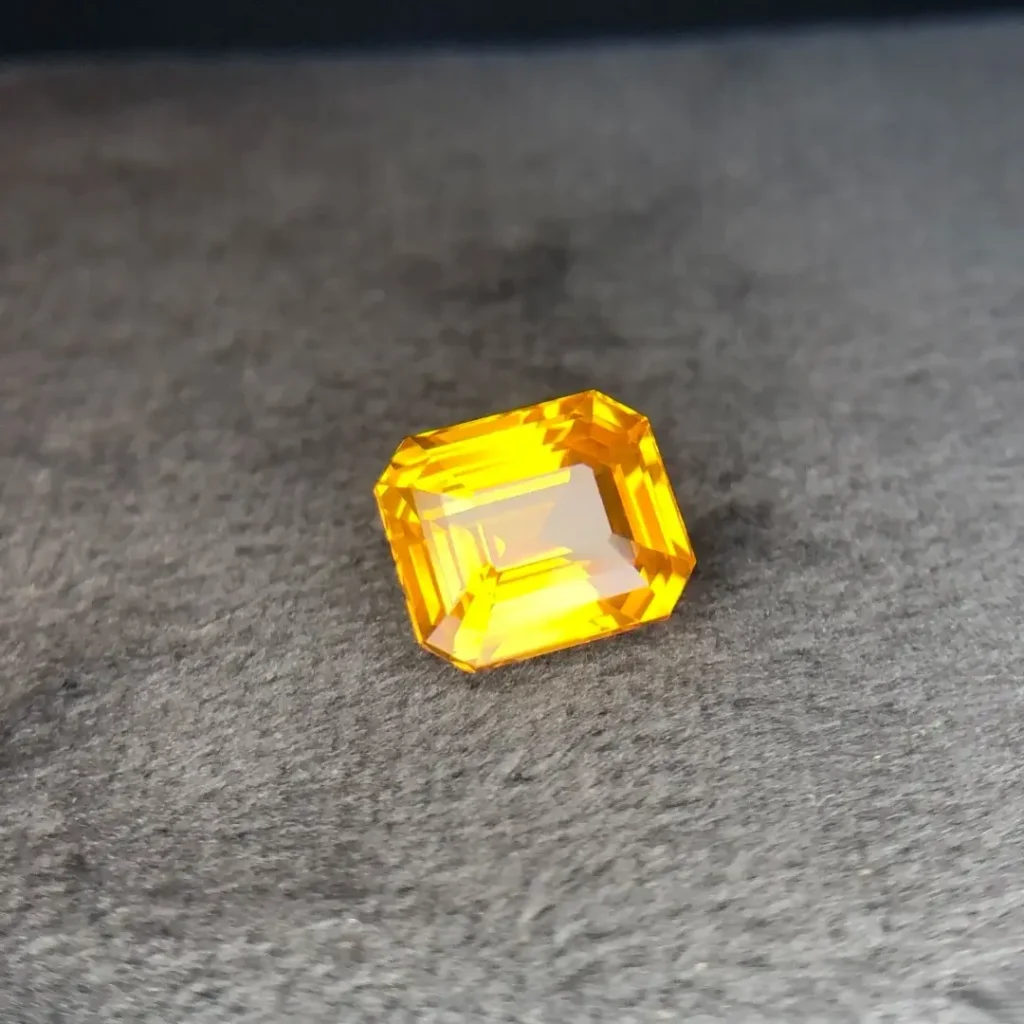
Now that we’ve covered color, stability, and treatment, it’s time to look at the overall quality of your Yellow Sapphire. Color is important, but a truly exceptional gemstone balances hue with clarity, cut, and carat weight—the classic “4Cs” that determine lasting value.
To explore this framework in greater depth, we break down each element in our PeonyJewels guide:How to Grade Gemstone Quality: Understanding the 4Cs and the Importance of Gemstone Cut Quality, where we explain how professional graders evaluate gemstones—and why cut quality often matters more than carat weight alone.
Evaluating Yellow Sapphire Clarity
Yellow Sapphires naturally exhibit higher clarity than many other sapphires. Choose stones that are eye-clean, with no visible inclusions disrupting their radiant appearance.
The Cut for Yellow Sapphires
The cut unlocks a sapphire’s brilliance. Opt for precise facets that reflect light evenly across the surface, minimizing dark areas and maximizing sparkle.
Carat Weight for Yellow Sapphires
Yellow Sapphires have a unique advantage—they occur more frequently in larger sizes. Stones in the 2–5 carat range often hit the sweet spot, offering impressive visual impact while remaining relatively accessible.
How to Care for and Clean Your Yellow Sapphire?
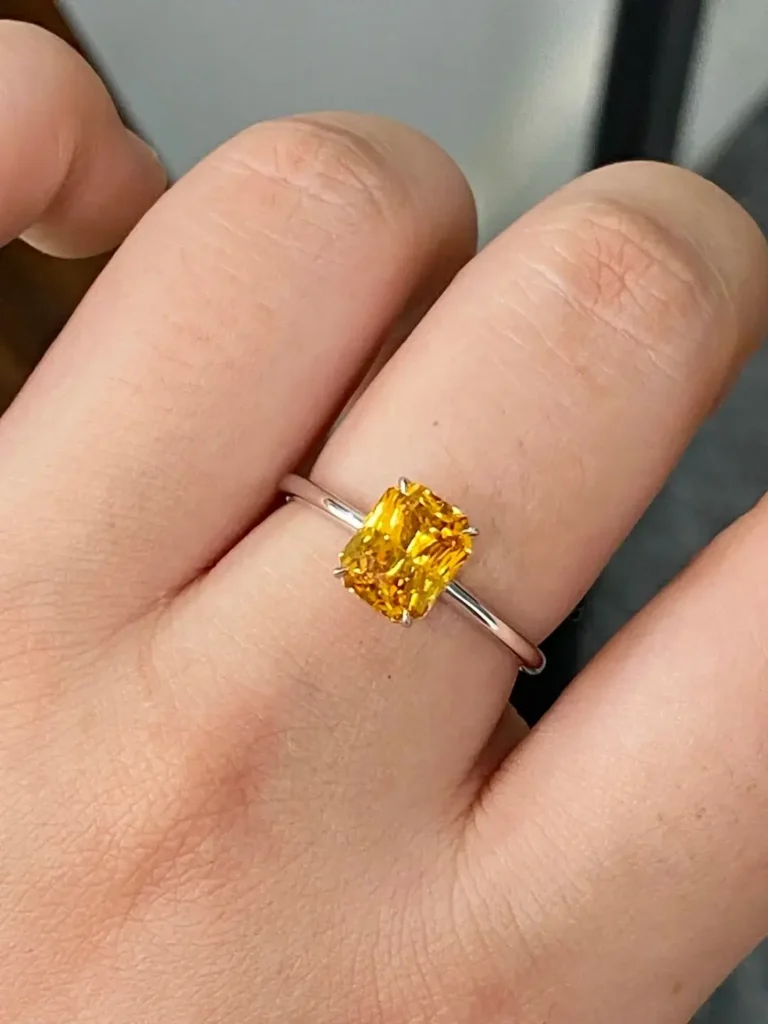
Even with a Mohs hardness of 9, Yellow Sapphires require mindful handling to retain their radiance. Follow these professional tips:
Protect from Physical Impact
Avoid wearing your sapphire during high-impact activities like sports or gardening, which can cause chips or scratches.
Shield from Harsh Chemicals
Keep your gemstone away from bleach, strong detergents, or other household chemicals that dull its vitreous surface over time.
Separate Storage
Store your sapphire in a soft pouch or individual compartment. Its hardness protects it from most scratches, but it can still be scratched by harder gems like diamonds.
Routine Cleaning
Gently scrub your sapphire with a soft toothbrush and mild soapy water to remove oils and residues. Regular maintenance preserves its brilliance and ensures it continues to glow for decades.
Bring Your Golden Vision to Life with Peony Jewels
Choosing a Yellow Sapphire is more than making a purchase—it is stepping into a journey of creating a timeless piece of history. At Peony Jewels, we transform raw natural beauty into exquisite, handcrafted jewelry. Whether you seek the fiery brilliance of a “Canary” gem or crave the vintage charm of an artisanal design, we turn your vision into reality with precision and artistry.
Yellow Sapphire Value: Understanding Our Pricing at Peony Jewels
We prioritize transparency in every transaction. When you source a stone through Peony Jewels, we guide you through the market to find the perfect balance of color, clarity, and value:
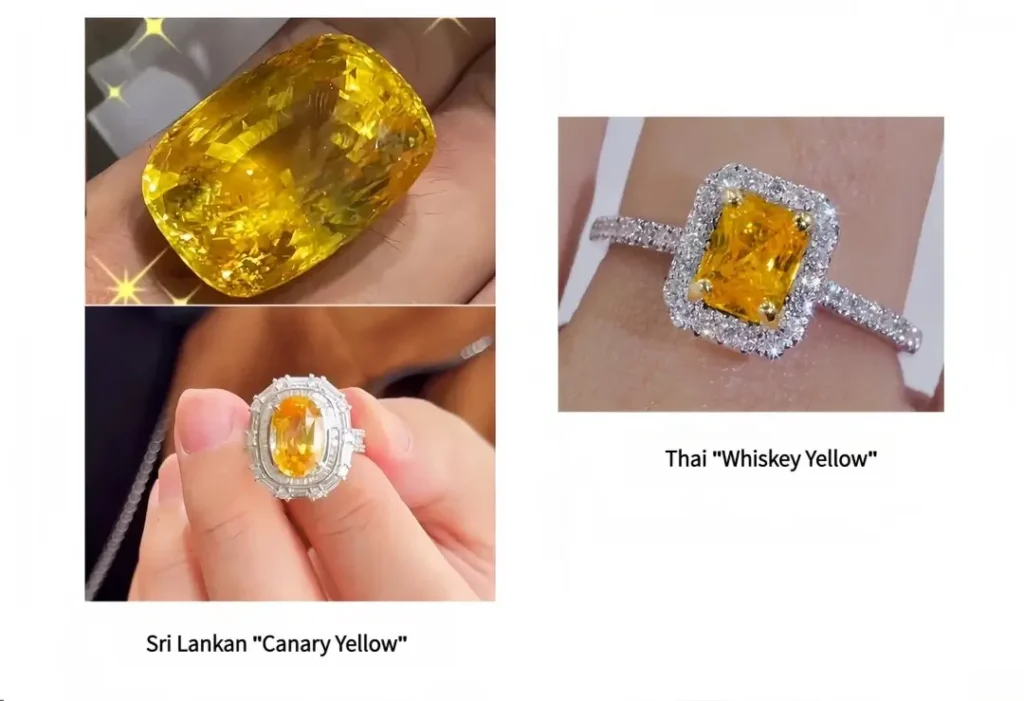
- Sri Lankan “Canary Yellow”: Top-tier stones with pure, vibrant yellow (no brown or gray undertones). Prices typically range from $1,400 to $8,500 per carat.
- Thai “Whiskey Yellow”: Warm, honey-like tones offering exceptional value—often 50% less than Ceylonese stones, ranging from $400 to $2,100 per carat.
Case Study: A Bespoke Yellow Sapphire Ring
Let’s look at a recent commission that highlights our commitment to quality and artistry:
The Client’s Choice: Radiant Octagon Ring
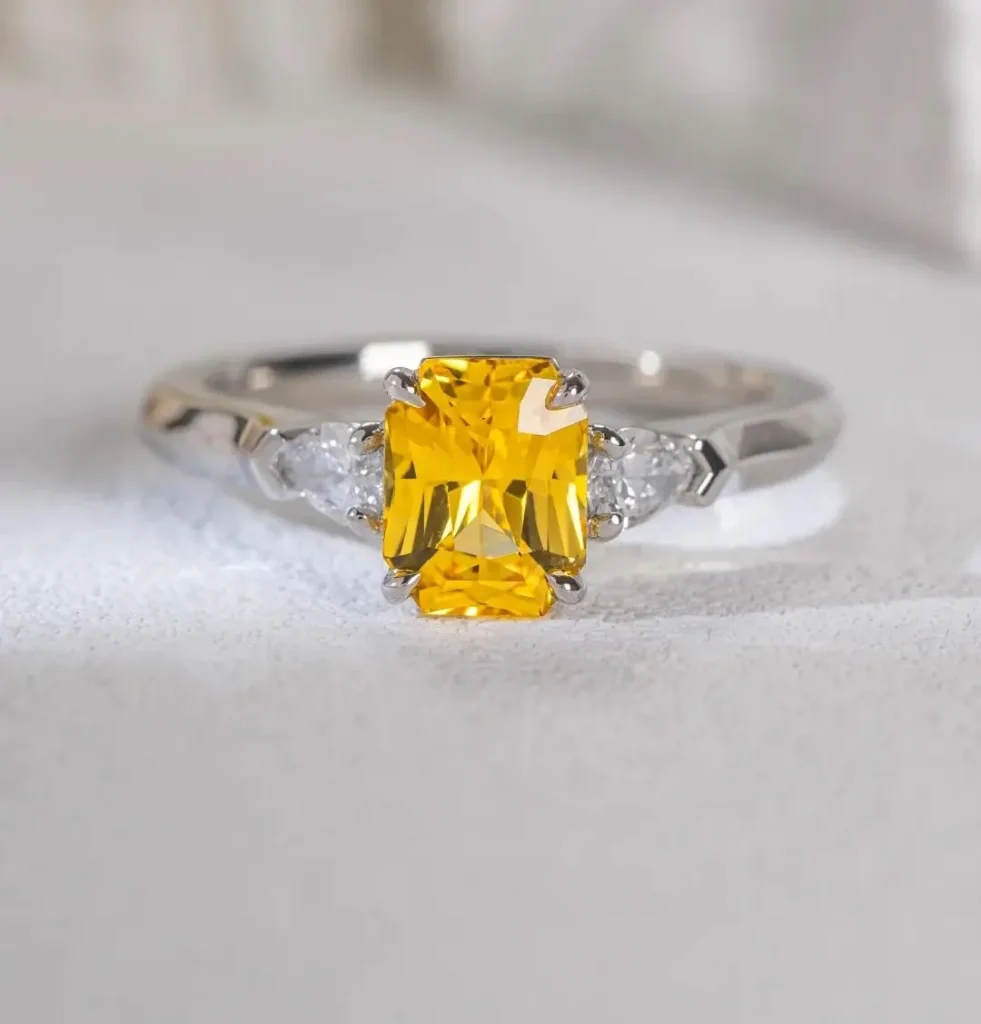
- Stone: Natural “Old Heat” Yellow Sapphire (Vitreous Clarity)
- Weight: 1.58 Carats
- Origin: Sri Lanka (Ceylon)
- Cut: Precision Octagon
- Setting: Handcrafted 18K Gold, Classic Four-Prong
- Certification: GRC Certified
- Investment: $1,000 (Loose Stone)
By choosing a traditionally heated stone, our client secured a vibrant, stable sapphire that rivals a $20,000 yellow diamond—for a fraction of the cost.
Start Your Bespoke Journey Today
You can own a Yellow Sapphire that remains radiant for a lifetime. At Peony Jewels, we do more than sell gemstones—we craft legacies. From our exclusive collection of handmade vintage earrings to fully bespoke rings, every piece is designed to reflect your vision and personality.
Connect directly with our Chief Designer, Shanyu, and let us help you source your perfect Yellow Sapphire. Explore our latest collection or schedule a consultation today, and turn your inspiration into a timeless masterpiece that glows as brightly as your future.